Showing posts with label Book. Show all posts

13 January 2015

Reading: Issues of representation - Maureen Furniss

In a brief chapter on the analysis of animation, Furniss dicusses issues of representation within animated film and television. 'Issues concerning representation and cultural diversity are many and varied' (232). She briefly discusses culture and racial representation, but mainly focusses in-depth on female representation and women's issues. This perhaps is because as a woman she feels qualified to speak at length on the subject, or has a vested interest in it; 'recognisiton of one's own values, or the values being employed in writing the study, is impervative' (233)
She speaks mainly from the point of view of not just theorists of animation as an art form, but analysts of the animation industry as a whole. The chapter talks extensively about the industry standards that influenced representation, and marketing practices that coloured the reasons by which animation was historically produced. She shows how privilege and power lead to poor or lack of representation of marginalised groups: 'sometmes, depictions reflect specific agendas' (232).

When talking specifically about lack of representation of women in animation, we learn from her about employment practices in the American animation industry in the early to mis 20th century.Unfortunately, 'in the field of animation ... historically the women had no voice at all' (234) and so could not offer their own points of view or representation. This lack of women animators is problematic, as 'male animation creators and directors usually do not design female characters who have substance and provide strong, positive role models' (240) and either create secondary, objectified and stereotyped characters, or else leave them out all together.

Today the animation industry is 'a system that remains male dominated' (241), but fortunately, especially recently, the role of women has become more important within it and more women are being employed and represented. 'The voice of women in animation has become stronger during the past several years' (234). 'One area of concern for today's animation producers is the way in which women and girls are represented in their productions' (238); this issue has increased by a rise in women demanding fair treatment; an increase in women animators; and an increase in feminist sensibilities amongst male ones.Maany female animators have used the form in recent years to subvert the traditional representations and standards, and some have gona as far as to say that 'animation as a form offers such potential to explore women's issues in a way that simply isn't possible in live-action' (243)

Many of my own favourite animators, and inspirations to me, are female artists. Especially in popular televeision through networks such as Nickelodeon, cartoon Network and Cartoon Hangover, women animators have become much more prominent, and I ahve noticed shows which feature impressive women characters, even ss produced by men. For example, Natasha Allegri has her own show on Cartoon Hangover called Bee and Puppycat which not only is female-produced, but it's main character is a girl.
Bee from Bee and Puppycat
In my favourite animated TV show, Adventure Time, many strong females are depicted and they are an intrinsic part fot hey show. They were created by Pen Ward, who chose to give time and effort to representing women in a positive and contemporary way.

Princess Bubblegum from Adventure Time

Reference:
Furniss, M. (1998). Issues of representation. In: M. Furniss, ed., Art in Motion: Animation Aesthetics, 1st ed. Sydney: John Libbey, pp.231-246.

Reading: Mise-en-Scene - Maureen Furniss

'Animation falls in the intersection of many artistic practices' (61). In this chapter, Furniss discusses individual elements in detail of what makes animention aesthetic unique, and what factors influence them.

'In the original French, mise-en-scene means 'staging an action,' and it was first applied to the practice of directing plays. Film scholars, extening the term to film direction, use the term to signify the director's control over what appears in the film frame. As you would expect from the term's theatrical origins, mise-en-scene includes those aspects of film that overlap with the art of the theatre: setting, lighting, costume, anf the behaviour of the figures. In controlling mise-en-scene, the director stages the event for the camera' - Bordwell and Thompson in Film Art.
Image design: In animations, image is split into two categories: characters and backgrounds. 'Audiences generally remember characters the most, but background art greatly impacts the viewer's perception and cannot be overlooked in a discussion of image design' (66) Images can be photorealist (look like real life), iconic (clearly representative), or abstract (suggestion of form). In my own animation, the ideal rendering of images will be 'iconic,' and so look cartoonish/created, but still very obviously be an animated representation of real life. Think Disney; Cartoon Saloon. Iconic designs can be interpreted easily and identifiable with by any audience; it doesn't have to represent a specific.
'Traditions of giving human charactersistsics to animals or inanimate objects have existed since the biginning of humanity, through oracticessuch as animism (the belief that everything on earth possesses a spirit and impacts on human life) and totism (the incorporation of natural entities into ritual behaviours)' (68). My crane is semi-anthropomorphic, and displays or isimbued with animism - she can regognise the woodcutter in her bird form, and displays awareness and intellegence. Think: the dogs in 101 Dalmations.

Colour and Line: The use of colour by animators/artists tends not to adhere to any strict formula, and is instead dependent on personal instinct or inspiration, though some artists still do study colour theory and apply it to their work. 'techincally, black, white and the gradiations of gray are not colours; they are 'values'' (72). They are used to indicate a level of light. Intensity is the colour's saturation on a subject, and how affected it is by dark or light. 'Low intensity is used to describe a relatively grey, or dull colour' (73). Colours also function as warm or cool (warms including yellows, reds, oranges; cools being blue, purple, green). These can have an effect on the viewer to stimulate them or calm then, and make themood happy or sad.
Colour can be used to suggest many things in an animated work - from being light and airy then growing darker and more complex, giving a sense of danger or claustrophobia.
Bold lines tend to be used in the subjects of power and strength (75), fine lines can indicate delicacy.

Movement and Kinetics: 'Objects can move fluidly and rhythmically; in short incremental bursts; slowly and hestitantly; or in a multitude of other ways that all suggest meaning' (76). Many animators use a live-action filminc reference which they will compose drawings from. I think I might maybe try to do this way; just filming myself making some key actions on my phone camera which I can base my poses off in the animation. I don't have confidence enough in my drawing skill to draw solely from imagination. This process is similar to rotoscoping, and creates realistic images. 'Squash and stretch lend a much more cartooy look to  a production' (77). This technique 'requires exaggeration' and 'relies heavily on metamorphosis.'
A 'full animation style' requires constant movement of the characters. The ability to employ this is related to economics, as it is 'time consuming and, as a result, costly to render constant movement' (79). Stillness, referred to as 'hold' is used for emphasis; because in real life living things are rarely completely still.

Reference:
Furniss, M. (1998). General concepts: Mise-en-scene. In: M. Furniss, ed., Art in Motion: Animation Aesthetics, 1st ed. Sydney: John Libbey, pp.61-81.

12 January 2015

Reading: Postmodern Fairy Tales - Bacchilega

My most recent reading into fairy-tale adaptation and re-structuring was Bacchilega's 'Postmodern Fairy Tales' (1997). All references in this blog post will refer to the first chapter form this book, titled 'Performing Wonder.' In Bacchilega's own words, 'this book explores the productions of gender, in relation to narrativity and subjectivity, in classic fairy tales and re-envisioned in late twentieth-century literature and media for adults.' (4) The first chapter functions as an introduction to her frameworks of analysis, including but not limited to feminism, postmodernism, and semiotics. It paves the way for more detailed analysis of specific fairy tale texts later in the book, which I will not delve in to at this point in time. Citing famous works by the likes of Zipes, Calvino, Carter and Warner; this piece offers an interesting divergence in opinion from other fairy tale theorists, and Bacchilega is not afraid to comment on and criticise the views of her predescessors.

The beginning of the chapter places Bacchilega's understanding of the difference between Zaubermarchen and fairy tales in opposition to my own; she emphasizes their contrast and places more importance on the media they are told through than I think is important: 'the classic fairy tale is a literary appropriation of the older folk tale' (3), which is true to an extent but not of pure vital importance. I personally see fairy tales as being a branch of marchen, or a section within its varied bounds, rather than a seperate but similar entity as Bacchilega seems to. She also focuses on the presumption that fairy tales are written with a child audience in mind, 'serving, more often than not, the civilizing aspirations of adults' (5), which from my previous readings I have found not to be the case. Instead, it seems which fairytales were written and performed for a mature audience, now modern adaptations have re-positioned then in their child-friendly re-workings as for a younger age group instead.
'Fairy stories play a role in education. Not only are children encouraged to retell or dramatize them in schools, but college students encounter them again in across-the-curriculum readers and in courses on children's literature and folklore.' (2) This I do agree with, though again I think it is symptomatic of modern interpretations and retellings rather than based on the original intentions of their writings.

Without specifying any particular adaptations, Bacchilega notes the prominence of appropriation by writers and tellers of fairy tales. 'The fairy tale, which provides well-known material pliable topolitical, erotic, or narrative manipulation. Belittled, yet pervasive and institutionalized, fairy tales are thus produced and consumed to accomplish a variety of social functions in multiple contexts and in more or less explicitly ideological ways.' (3) This is where the postmodernist structure for examining recent fairy tales and tellings comes in; Bacchilega suggests that the dual function of them both analyzes their original intertext's social project, and also re-inscribes them with new semiotic meanings relevant for a modern age (ar at least, this is how I understood her meaning!) In some instances of adaptation, tales 're-place or relocate the fairy tale to multiply its performance potential and denaturalize its institutionalized power' (23). 'Re-vision is not merely an artistic but a social action, suggesting in narrative practice the possibility of cultural transformation' (23)

'the fairy tale magically grants writers/tellers and readers/listeners access to the collective, if fictionalized past of social communing, an access that allows for an aparently limitless, highly idiosyncratic re-creation of that "once there was."' (5) In admiration of Carter's focus on fairy tale telling as a means to subvert opression by opressed peoples, Bacchilega metions the importance of the tale in all social classes as a liberator of expression and opinion: 'the fairy tale proves to be everyone's story, making magic for all' (6). The problem arrises when the writer or narrator does not take responsibility for their personal situation's influence, and instead presumes a 3rd person objective position. Different narratives between folk tellers and fairy tale writers often symbolize 'different needs and aspirations for different social groups' (6) which is important to understand when reading from a diverse group of tales.

A theory suggested in this chapter I find to be particularly interesting, and I have not come across it yet in any form. It is to do with the prominence of a naturalized magic within folk and fairytales which goes unacknowledges by either the characters within a story or the narrators themselves. 'We know that in folk and fairy tales the hero is neither frightened nor surprised when encountering the otherwold, receiving magic gifts, holding conversations with animals,or experiencing miraculous transformations. The numinous is artfully made to appear natural' (9) The question being, is this to disguise its artifice and social project? Bacchilega states the fairy tale is imbued with 'that magic which seeks to conceal the struggling interests which produce it' (7). The wonder of the wonder-tale is accepted by the readers/ listeners with a suspension of disbelief, and its purpose is to disguise the politics of the telling, and also to make the consumer more easily accept it without question, as they do with magic.

Carrying on this line of thought, it is applied to a feminist perspective in Bacchilega's analysis. 'This disguise seems doubly pervasive and dangerous when assumed by tales centering upon the experiences of women.' This is because of a 'long tradition of representing women both as nature and as concealed artifice' (9) like the concealed artifice of magic. It becomes symbolic of the construction of women in fairy tales: to go unquestioned in their representations.

'Women are commonly identified as being closer to nature than to culture, which in a patriarchal system makes them symbolic of an inferior, intermediate order of being'. 'Assosication of woman with nature paradoxically produces the artifice of 'femininity,' both as naturalizing make-up and as representations of womanly 'essence.' (9) Returning here to the idea that for men, the conflict of women's artificiality vs. true nature/form is an often recurring topic within fairy tales and their adaptations (see: Disney's representation of villainous women as made-up, concealed, and fake)

Reference:
Bacchilega, C. (1997). Postmodern fairy tales. Philadelphia: University of Pennsylvania Press.

Reading: Modes of Animation Production - Maureen Furniss

'Industrially and independently produced animation are not completely separate modes of production, but are in fact interrelated in complex ways' (29)
 These two modes cannot be seen as separate entities, but characterised only in relation to each other. This is a similar case to live action films. Furniss creates a table to represent the contrast between the extremes of the two modes (30); I have transcribed this below including only the points which I find relevant to my own current work. The paradigms of the 'independent' column shape my work more.

Traditional/ industrial/ hegemonic: 
  • Big budget
  • Made in groups
  • Dominated by marketing concerns
  • Support dominant beliefs
  • Reflect concerns of dominant social groups
Independent/ experimental/ subversive:
  • Small budget 
  • Made by individuals
  • Limited to small-scale exhibitions
  • Made by marginalised social groups
  • Dominated by aesthetic concerns
This is not to say that I, as an independant animator, am not influenced by systems of distribution and exhibition. 
'Many independent animators have worked as fine artists in various media,' (32) which is how I first discovering my enjoyment of animating; after developing an affinity and talent for art through my teen years. Moving on to animation felt like an extention of this. 'A great many animators who began as artists working in the realms of still drawing or painting have become interested in animation because it offers an opportunity to set their images in motion' (33).
Reference:
Furniss, M. (1998). Alternatives in Animation Production. In: M. Furniss, ed., Art in Motion: Animation Aesthetics, 1st ed. Sydney: John Libbey, pp.29-33. 

9 January 2015

Reading: Angela Carter and the Fairy Tale (Introduction)


'Carter was drawn to the fairy tale as a vehicle of sociopolitical commentary'
(Roemer and Bacchilega, 2001)
Angela Carter's works, and her philosophy on the appropriation of folktales, has been a huge inspiration to me in my studies and animation work this semester. I picked up a book, entitled  Angela Carter and the Fairy Tale (Roemer and Bacchilega, 2001) which originally appeared as a special edition of the paper Marvels & Tales in 1998. I will go into detail in further posts about the individual contributions by various writers to the issue; for now I want to focus solely on the introductory chapter.
This chapter sees the authors give a general introduction to the world of Carter's writing, but more interestingly I found, an overview to the genre of folktales. Roemer and Bacchilega discuss the origins of folktales and their development through the years to become the fairy tales and marchen we know and adapt today. The terminology and semiotic differences between all of these terms I have found confusing, and previous explanations have been contradictory, but thankfully I found this piece to clear up the ideas in my mind.

'According to the Grimms' Deutsches Woterbuch, Marchen meant simply a "fictional tale,"' which is how I had come to understand the phrase. I generally lump all of folklore/tales/ fairy tales into this category together, and it seems I haven't been too far wrong: The Grimms placed 'diverse subgroups of folktales within the larger category of Marchen.'
'Marchen was typically rendered as "popular story" "wonder tale" or "fairy tale." Interestingly, the latter term derived not from any Germanic perspective but from the earlier translation into English of the seventeenth century French term conte de fées, which referred to narratives with supernatural beings as characters.' These 'supernatural' being tended towards fairies, hence the name, yet also included characters like beasts, metamorphosing humans, talking animals, etc. This means that tales that didn't include the fairy godmother character can still be included in fairy tale analysis. '[Carter] diffuses terminology by labeling "fairy tale" as a "figure of speech," moreover one used loosely to describe the great mass of infinitely various narrative that was, once upon a time and still is, sometimes, passed on by word of mouth.' All of this explanation provides clarity to me in studying folk and fairy tales. To understand the origin and terminology of these stories to begin with, gives me a better means of socio-politically contextualizing them.

We tend to think of the Grimms' and Perrault's adaptations as coming directly from folklore, as heard from peasant mouths directly. Apparently, they come less directly from the folk classes, and tend to be more attributed to bourgeoisie than supposed. Rather than talking to peasants and working classes to get their stories, the Grimms would work from written sources, journals, reviews etc; The Grimms would 'flesh out these verbal skeletons as their own perspectives inclined them. They reinforced the Christian aspects, the homey sayings, and the violence, while deleting sexual references.' 'The resulting tales were not primarily indicative of peasant values but those of the German middle class.' This was similar to what happened with the French tales in the case of contes de fées. 'The Grimms acted in accordance with the romantic perspectives of their day in focusing on the material rather than taking into account the socioeconomic conditions of the tales' informants.' As Carter has stated, the fairy tale was supposed to be a means of sociopolitical commentary, but in editing these stories in such a way, the Grimms and Perrault took away some of their embedded meanings and the voice away from the lower classes, to adapt it to tell the conditions of the higher classes instead.

'The contes de fées, like the oral tales still being told at salons, had specific sociopolitical functions. Informed by female perspectives and featuring female characters, the contes offered their creators opportunities to critique conditions of the day, particularly the social institution of forced marriage and the general lot of women in a predominantly male-controlled world.' Even though the class issue was being removed from them, they still served as a powerful tool by the 2nd class citizens (women) to provide commentary and criticisms of their situation. Although the now famous writers tend to be men, such as Perrault, in actuality it was the female attendees of the salons who provided the bulk of writing and analysis of fairy tales during the revival of the contes in France.

'The intermixing of folk (however folk may be defined), literary, and, in the twentieth century, mass media versions of fairy tales, sets in motion, in Carter's words, the transnational and "endless recycling process" of storytelling. It is the "user-friendly" nature of the tales which allows them to participate in a powerful "public dream".' 


References: 

Roemer, D. and Bacchilega, C. (2001). Introduction. In: D. Roemer and C. Bacchilega, ed., Angela Carter and the Fairy Tale, 1st ed. Detroit: Wayne State University Press, pp.8 - 12.

6 January 2015

Reading: 'From the Beast to the Blonde' by Marina Warner

Book: Warner, M. (1995). From the Beast to the Blonde. London: Vintage.

I read one of Warner's (massive) books about folklore and fairy tales, focusing on their adaptation and remediation throughout the years from their humble origins in mainland Europe to Hollywood blockbusters today. It delves into as much study about the tellers of these tales, as of the stories themselves. We learn about the reasons for their invention and the huge popularity of them in the past centuries. Unlike some of the others readings on the subject, I learned less in this book about the modern day consumption of fairy tales, but I did discover a lot about their origins, and societal and academic importance, which has been very interesting to learn about and I hope will help me to have a better understanding of the genre as a whole. I noted the parts which were most concerned with the type of animated tale I will be making, and will discuss them below.

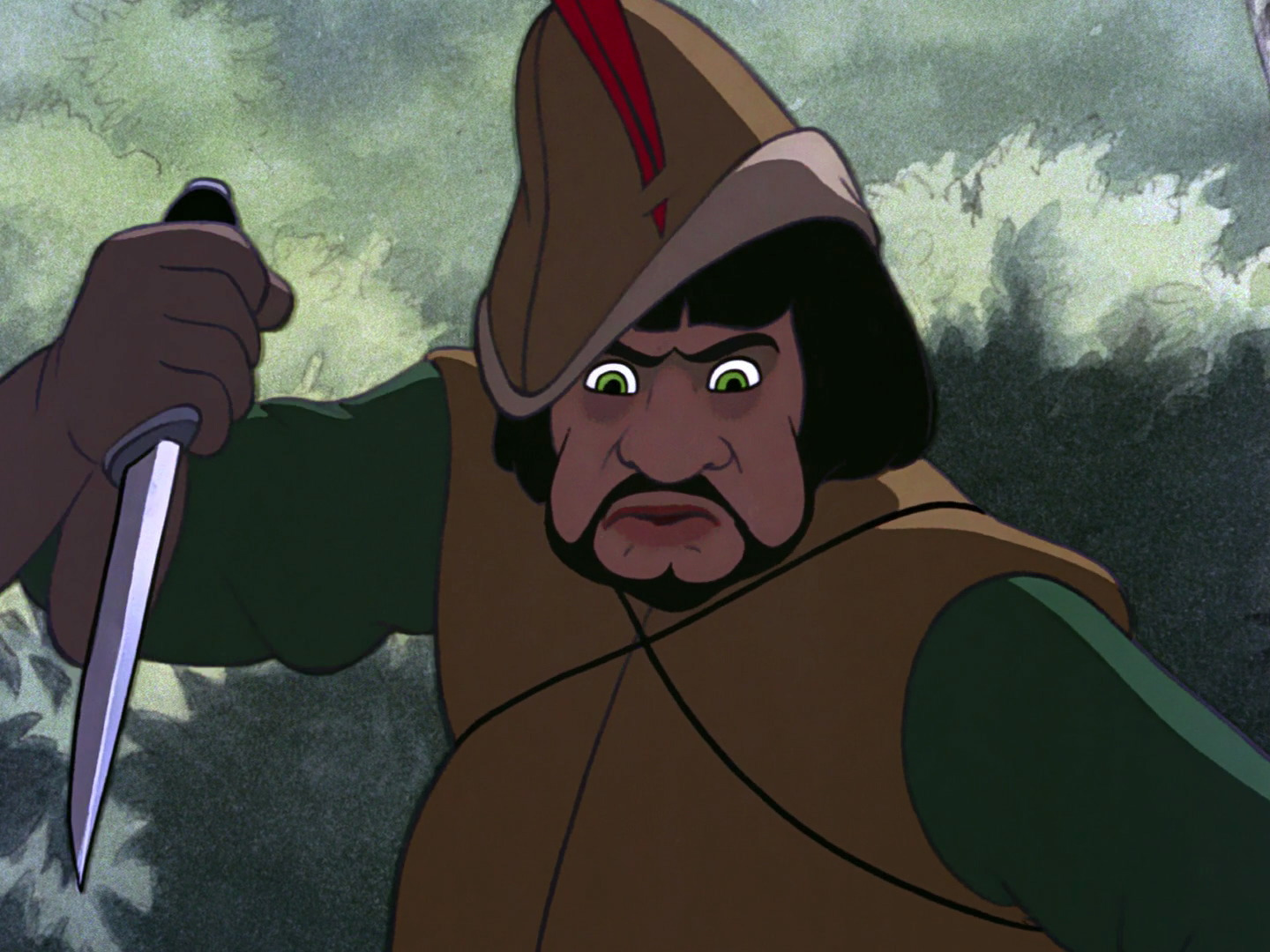
Beardedness signifies strong men. 'Beards were the mark of the goat, and given the goat's lustful and diabolical character, its kinship with satyrs, and the Devil himself...Beards came increasingly to define the male in priapic mode' (pp.242). Beards are given the symbolic value traditionally in story telling, so I want to avoid associating my main character of the Woodcutter with any of these overtly masculine or sexual overtones: I will forgo giving him any type of facial hair, and instead contrast him with a heavily bearded huntsman who represents all the power, cruelty lust and desire that the Woodcutter is not. None of the Disney princes/ heroes have beards, which is significant.
Disney's Huntsman from Snow White source: http://img4.wikia.nocookie.net
Manly Dan from Gravity falls source: http://images6.fanpop.com/image
The book delves into reflection on the prevalence of romances between animals and humans; beasts and beauties as they appear over and again in folk tales. Apuleius' tale of Cupid and Psyche is the first forerunner of these type of tales; Eros being the 'first beast of the west.' The immortal god and the mortal beauty make love, while Psyche is forbidden to look upon her lover. When she can 'resist no longer, and breaks the prohibition, lighting a candle...he vanishes. Psyche's failure to trust, and to obey, has cost her his adorable presence and his love' (pp.273). There is a significant comparison between this tale and that of The Crane Wife, though the roles are gender-bent, which is perhaps more suited to a contemporary, feminist-positive take on the situation. The crane has forbidden her husband to look on her while she weaves, but he grows curious and disobeys her. This too, like Psyche, loses him his lover. Later in this discussion however, Warner observes that the gendered roles in Cupid and Psyche are unusual, instead typically it is 'more common to find knights errant than maidens in pursuit of their lovers' (pp.275)
Cupid leaving Psyche, source: http://upload.wikimedia.org/wikipedia/commons

In beast/human tales, the beast is 'identified with male sexuality which must be controlled or changed or domesticated through civilité' (pp. 280). This way of thinking existed mainly at a time when animals were thought of as savage, and the stories typically end badly for the beast creature (again, usually presented as the male protagonist or villain). In more recent times, sensibilities have changed and we have 're-evaluated' our stance towards animals. Now 'the beast is perceived as a principle of nature within every human being, male and female, young and old.' My representation of the female protagonist taking the form of a crane is in line with this modern representation. She isn't constructed as harmful or dangerous, but still does need to be domesticated.
La Belle et la Bete source: http://blog.felix-culpa.gayattitude.com/picture

This type of fairy tale also had a popular recurring theme, that the 'beauty is the beast' (pp.283). That is, not only does the beast metamorphose, but the beauty takes advantage of this also, which leads her to an escape from a 'tyrant' father or husband. The beauty here not necessarily being placed opposite a beast, but the theme of the contrast between mortal human (female) and wild animal remains. 'In a female protagonist's case, shape shifting also shifts the conditions of confinement.' For example, in the She-Bear tale, Princess Hawthorn 'acquires more freedom of movement [as a bear] than as a woman, and more freedom of choice.' This is reflected in the independence and freedom of movement granted to the Crane in her bird-form: she literally can move further and faster away by flying, but also, figuratively, can escape from her marriage and return to the magical world away from the domestic confines of her home with the Woodcutter. She does not merely leave her husband, she chooses that for her ultimate freedom she must also change form to do so.
A Selkie: a woman who can escape to sea in seal form. Source: http://simonsylvester.files.wordpress.com
'Whereas male beasts are cursed by some malignant force, the heroines of fairy tales are willingly bound by a spell; they frequently agree with the alacrity to the change of outward form, in order to run away from the sexual advances of a father or would-be seducer' (pp. 353). When we think of cursed heroines, we picture them locked away like Sleeping Beauty, or like Rapunzel, being cursed with long hair. The Beauty and the Beast's prince however, is given animal form. the Frog Prince is forced to become a frog until he finds a princess' love. Even of these two examples, neither are willing. From what shape-shifting females we do know though, they seem to have been born this way or given unknown origins: think of the Little Mermaid, selkies, and The Crane Wife. 'The bodily transformations of female heroines take them across thresholds' (pp. 354). This is the 'phenomenon of liberty' as Warner calls it. The apparent degradation of taking on 'beastly' form works for the heroine, not against her, unlike her male counterpart. She can take 'control of her own identity' and not have it thrust upon her. 

Adventure Time - The Art of Ooo 2

Below are a lot of guidelines on the drawing of the main characters; Finn and Jake, by the show's creators. They are used to help the animators keep their work consistent and the look of the show always fluid. I am already totally in love with this book, as it not only shows finished pieces and grabs from the show, but also all of the concept and development art. It discusses the processes the artists had to go through to create and finalize all of their characters and worlds, which is super useful to me!


Adventure Time: The Art of Ooo 1


The two above images are exterior views of the Treehouse, Home to Finn and Jake. It shows the scene during two different times of day: one in the dark of night and one in the soft glow of sunrise. i love how the colours change between the two and give a distinctive mood to each picture.

 Interior to the Treehouse - background work. The photo quality here is awful, but I loved how it was a wide-angle view of the room. I want to use the wood paneled walls and tree trunk stabilizing pillars as inspiration for the Woodcutter's cabin.

30 November 2014

The Crane Wife (1998) retold by Odds Bodkin

Bodkin, O. and Spirin, G. (1998). The crane wife. San Diego: Harcourt Brace.
Staying true to the orginal Japanese telling, this version of the story employs very Japanese-inspired illustrations, which look like screen prints and painting of old from ancient Japan. 
The scenes an figures are painted in a flattened, 2D style. The background landscapes of mountains employ little shading or depth, and so suggest perspective while still looking quite flat. It reminds me slightly of cartoonish-style that is used in many animations. 
The colours used are rich tones of golds, ochres and rust. They look more autumnal than I would choose for my own piece. Other than the living subjects, the rest of the painting is loosely formed without heavy line work. Shapes blend easily in to one another and suggest their structure more than actually define it. The buildings and man-made structures contrast greatly with the surrounding nature by having definite straight edges and geometric shapes. 

In this telling of the story, the man is called Osamu. He is a sail maker rather than a wood cutter.
S

'Red leaves fell on the dark wood of his porch.' 'There lay a great crane, stunned and still.' 'Soon its black, shining eyes opened.' Because it is set in japan, the species of the crane in this book is different from the one I would be basing my crane on. It has black rather than golden eyes, and it all white like a swan, with no black or red. 


'A beautiful young woman gazed up at him, her black eyes shining.' 'Osamu asked her many questions, but all the young woman would tell him was that her name was Yukiko.' 'You must promise never to look at me as I work, she said.' 'It takes all that I am to weave such sails.' 'These sails, they take so much from me, she pleaded. It is my very self they take.'


'Unable to contain himself, Osamu ran around the screen. A long beak swung toward him. Sad black eyes gleamed at him. There stood the crane he had saved in the storm!' 'The bird was weaving its white feathers into the sail on the loom.'


'The only answer his crane wife could give was a soft, strange sound, like a cat purring in bamboo reeds. Then Yukiko spread her wings, lifting herself through the window and into the sky.'


'Never again did Osamu see her.'


12 October 2014

Japanese Children's Favourite Stories (1995)


Finally last night my book arrived in the mail from home. After spending the past few days reading folklore stories online through my laptop screen, it was such a nice change to be able to hold a physical copy of this book in my hands. I pored through the stories eagerly, pausing on each of the beautiful illustrations.They are hand pained in a traditional Japanese style using block colours, and provide so much inspiration for the direction I might take my artwork in. The book is heavy and each of the pages thick and glossy, and reminds me vividly of my childhood.


The versions of the stories in the book vary greatly from some of the versions I found online. In some cases, the titles had changed and I only recognised the tale when I was partway through reading it, and in other cases whole settings or characters were changed.