My most recent reading into fairy-tale adaptation and re-structuring was Bacchilega's 'Postmodern Fairy Tales' (1997). All references in this blog post will refer to the first chapter form this book, titled 'Performing Wonder.' In Bacchilega's own words, 'this book explores the productions of gender, in relation to
narrativity and subjectivity, in classic fairy tales and re-envisioned
in late twentieth-century literature and media for adults.' (4) The first chapter functions as an introduction to her frameworks of analysis, including but not limited to feminism, postmodernism, and semiotics. It paves the way for more detailed analysis of specific fairy tale texts later in the book, which I will not delve in to at this point in time. Citing famous works by the likes of Zipes, Calvino, Carter and Warner; this piece offers an interesting divergence in opinion from other fairy tale theorists, and Bacchilega is not afraid to comment on and criticise the views of her predescessors.
The beginning of the chapter places Bacchilega's understanding of the difference between Zaubermarchen and fairy tales in opposition to my own; she emphasizes their contrast and places more importance on the media they are told through than I think is important: 'the classic fairy tale is a literary appropriation of the older folk tale' (3), which is true to an extent but not of pure vital importance. I personally see fairy tales as being a branch of marchen, or a section within its varied bounds, rather than a seperate but similar entity as Bacchilega seems to. She also focuses on the presumption that fairy tales are written with a child audience in mind, 'serving, more often than not, the civilizing aspirations of adults' (5), which from my previous readings I have found not to be the case. Instead, it seems which fairytales were written and performed for a mature audience, now modern adaptations have re-positioned then in their child-friendly re-workings as for a younger age group instead.
'Fairy stories play a role in education. Not only are children encouraged to retell or dramatize them in schools, but college students encounter them again in across-the-curriculum readers and in courses on children's literature and folklore.' (2) This I do agree with, though again I think it is symptomatic of modern interpretations and retellings rather than based on the original intentions of their writings.
Without specifying any particular adaptations, Bacchilega notes the prominence of appropriation by writers and tellers of fairy tales. 'The fairy tale, which provides well-known material pliable topolitical, erotic, or narrative manipulation. Belittled, yet pervasive and institutionalized, fairy tales are thus produced and consumed to accomplish a variety of social functions in multiple contexts and in more or less explicitly ideological ways.' (3) This is where the postmodernist structure for examining recent fairy tales and tellings comes in; Bacchilega suggests that the dual function of them both analyzes their original intertext's social project, and also re-inscribes them with new semiotic meanings relevant for a modern age (ar at least, this is how I understood her meaning!) In some instances of adaptation, tales 're-place or relocate the fairy tale to multiply its
performance potential and denaturalize its institutionalized power' (23). 'Re-vision is not merely an artistic but a social action,
suggesting in narrative practice the possibility of cultural
transformation' (23)
'the fairy tale magically grants writers/tellers and readers/listeners access to the collective, if fictionalized past of social communing, an access that allows for an aparently limitless, highly idiosyncratic re-creation of that "once there was."' (5) In admiration of Carter's focus on fairy tale telling as a means to subvert opression by opressed peoples, Bacchilega metions the importance of the tale in all social classes as a liberator of expression and opinion: 'the fairy tale proves to be everyone's story, making magic for all' (6). The problem arrises when the writer or narrator does not take responsibility for their personal situation's influence, and instead presumes a 3rd person objective position. Different narratives between folk tellers and fairy tale writers often symbolize 'different needs and aspirations for different social groups' (6) which is important to understand when reading from a diverse group of tales.
A theory suggested in this chapter I find to be particularly interesting, and I have not come across it yet in any form. It is to do with the prominence of a naturalized magic within folk and fairytales which goes unacknowledges by either the characters within a story or the narrators themselves. 'We know that in folk and fairy tales the hero is neither frightened nor surprised when encountering the otherwold, receiving magic gifts, holding conversations with animals,or experiencing miraculous transformations. The numinous is artfully made to appear natural' (9) The question being, is this to disguise its artifice and social project? Bacchilega states the fairy tale is imbued with 'that magic which seeks to conceal the struggling interests which produce it' (7). The wonder of the wonder-tale is accepted by the readers/ listeners with a suspension of disbelief, and its purpose is to disguise the politics of the telling, and also to make the consumer more easily accept it without question, as they do with magic.
Carrying on this line of thought, it is applied to a feminist perspective in Bacchilega's analysis. 'This disguise seems doubly pervasive and dangerous when assumed by tales centering upon the experiences of women.' This is because of a 'long tradition of representing women both as nature and as concealed artifice' (9) like the concealed artifice of magic. It becomes symbolic of the construction of women in fairy tales: to go unquestioned in their representations.
'Women are commonly identified as being closer to nature than to culture, which in a patriarchal system makes them symbolic of an inferior, intermediate order of being'. 'Assosication of woman with nature paradoxically produces the artifice of 'femininity,' both as naturalizing make-up and as representations of womanly 'essence.' (9) Returning here to the idea that for men, the conflict of women's artificiality vs. true nature/form is an often recurring topic within fairy tales and their adaptations (see: Disney's representation of villainous women as made-up, concealed, and fake)
Reference:
Bacchilega, C. (1997). Postmodern fairy tales. Philadelphia: University of Pennsylvania Press.

Showing posts with label Remediation. Show all posts
Showing posts with label Remediation. Show all posts
12 January 2015
20 December 2014
Fairy Tale Re-imaginings by Na Young Wu
Na Young Wu is a Korean artist who re-imagines classic fairy tales (especially ones with Disney animated adaptations) in an Eastern setting, styled with traditional Korean clothes.

In this take on Snow White, she has used the iconic blue and white colours for the fabric of Snow's dress, as taken from the Disney version. The scene being illustrated is one of the most memorable from Disney's Snow White; where the heroine is lost and alone in the woods, and sings to the woodland creatures. She maintains the characteristic pale skin and raven hair of the intertext's protagonist.

This illustration shows The Little Mermaid's Ariel conversing with the evil Ursula. This scene seems to have been inspired by the Disney version less so than the previous picture. Save for the aqua-green mermaid's tail, the heroine does not keep any of the same clothes or colourings of Disney's Ariel. Ursula diverts from the ugly-female-villain trope, and instead is objectively beautiful, and youthful too. This creates an interesting dynamic between the two and subverts a usual anti-feminist failing of marchen.

The illustration for the princess and the frog is one of the most obviously differing from it's Disney version in the physical aesthetics of the heroine. She is a different ethnicity from the course text, as are all the others, but she retains a pale skin while Tiana in Disney's version is black. The scene shown comes directly from the intertext and is a scene not actually shown in the film.

In Beauty and The Beast, the Beast character is re-imagined not as a nondescript monster, but instead as a tiger: a 'beast' of an animal, and one native to the lands of Eastern Asia where the location is set. Belle or Beauty is still depicted as a young, beautiful woman. the tree is a Japanese maple by the looks of it, which wouldn't have appeared in Disney's French-set version,

The Snow Queen is uniquely pale and ashen-haired, which is unlike typical East-Asians' dark features. The only thing that places this piece in Korea is the style of her garments and hair accessories. Unlike the Disney version, 'Frozen,' this scene seems more other-worldly, instead of ties to a specific time and location.

18 December 2014
Adaptations of Little Red Riding Hood
The tale of little
red riding hood has been adapted by a ‘plethora of narrators’ (pp 89),
including books, cartoons, video games and films. It carries with it a
significant theme of criminality, which makes it interesting for adaptation. Unlike
most other well-known fairy tales, it has no hegemonic Disney version, making
it more present for broad exploration (Greenhill & Kohm, pp.92). Those who
are most familiar with the Grimms’ version of the story may be ‘shocked or
offended’ by some film versions, in which licence is taken by the writer to
sexualize Red Riding Hood; kill off any one of the characters, or re-set it in
a different period or location.
In this study, Greenhill and Kohm investigate a Japanese
anime revision of the story. In Jin-Roh
(1999) the action takes place in an apocalyptic world where Germany has won
WWII. Corrupt governments rule, and so a resistance force emerges, which uses
young girls known as ‘Red Riding Hoods’ to transport weapons. According to
Greenhill and Kohm, it is reminiscent of ‘Perrault’s version than of the Grimms’
version,’ (pp. 90) as the ending is tragic rather than victorious for the
hero(ine).Jin-Roh uses a lesser-known
version of the tale to ‘destabilize the audience’s sense of ease’ (pp.91). The
film uses animation to deal with the serious and tragic. ‘Indeed, the form
arguably increases the viewer’s sense of horror in its implicit juxtaposition
with conventional European and North American expectations that associate
animated films with material for children and that drawings distance their
subjects more than photographs’ (pp. 104)
This is contrasted to the 2005 western animated adaptation;
Hoodwinked! Unlike the former, this
film is geared more towards a younger audience, as most fairy tales and stories
would originally have been. This telling sees Red Riding Hood and her
grandmother as ‘cookie capitalists’ (pp. 90). In keeping quite true to the
Grimms’ version of the tale, the audience is allowed to feel ‘comfortable in
their knowledge of the fairy tale and thus in their own judgement of the facts
of the case.’
Storytelling is patterned,
but there is a significant importance placed on how the story is framed. Narratives
differ due to the experience of the storyteller. In Hoodwinked! the camera view ‘is the arbiter of fact. The audience
knows each personal experience narrative’s truthfulness because it is presented
mainly from the camera’s perspective - sometimes simultaneously with voiceovers
from the tellers’ (pp.97). Visual evidence is presented as reliable, even
though it comes from the point of view of one specific teller. In Jin-Roh the narrative can be confusing;
some state it is Little Red Riding Hood
as told from the wolf’s point of view. It narrates from multiple viewpoints throughout
the story.
Both these films are animated retellings of the
intertext, as I am hoping also to achieve with The Crane Wife. Comparing these two films ‘fosters exploration of
modes of storytelling connecting fairy-tale, filmic, and legal discourses’ (pp.
90). The authors attempt to illustrate how analysis of film discourses can
influence fairy tale studies themselves. They bring in to play questions of ‘narrative
style and textual authority.’ Until only relatively recently, fairy tales were
available only orally or as written texts. Discourses such as this have become
increasingly relevant as adaptations spring up in different media.
Reference:
Greenhill, P. & Kohm, S. (2013). Hoodwinked! and Jin-Roh: The Wolf Brigade. Marvels & Tales, 27(1), pp.
89-108
17 December 2014
Adaptations of Intertexts
Literary scholar Kevin Paul Smith posits eight possible ways for fairy-tale intertexts to work in literature, which also work equally as well in film and other media:
authorized (explicit in the title),
writerly (implicit in the title),
incorporation (explicit in text),
allusion (implicit in text),
re-vision (giving an old tale a new spin),
fabulation (creating a new tale),
metafiction (discussing fairy tales),
and architextual/chronotopic (in setting/environment)
The concept I have for The Crane Wife is for it to be an 'incorporation,' as the text will be clearly based on the story as an obvious adaptation (or at least, to anyone who is familiar with the tale). I am not sure yet what the title of my project will be, so as to whether it will fall under the authorized, writerly (or neither) categories remains to be seen. The action is taking place in a fairy-tale setting with anthropomorphically conscious animals and magical happenings, which lends to the architextual/chronotopic category.
authorized (explicit in the title),
writerly (implicit in the title),
incorporation (explicit in text),
allusion (implicit in text),
re-vision (giving an old tale a new spin),
fabulation (creating a new tale),
metafiction (discussing fairy tales),
and architextual/chronotopic (in setting/environment)
The concept I have for The Crane Wife is for it to be an 'incorporation,' as the text will be clearly based on the story as an obvious adaptation (or at least, to anyone who is familiar with the tale). I am not sure yet what the title of my project will be, so as to whether it will fall under the authorized, writerly (or neither) categories remains to be seen. The action is taking place in a fairy-tale setting with anthropomorphically conscious animals and magical happenings, which lends to the architextual/chronotopic category.
13 December 2014
Reading: Three Revisions of Snow White - Cristina Bacchilega (1988)
I read an article about remediation of a folk/ fairy tale, which in this case was the popular story of Snow White. I thought this would be an interesting aspect to study, as the remediation of a tale is the main subject I will be dealing with. For centuries storytellers have retold tales in their own
ways, embellishing the plot' with details peculiarly representative of both
the individual teller and his [or her] time' (Bacchilega, 1988, pp. 1). The aim for the narrator/ story teller in a revision of the folk tale is to 'reinvigorate' the tale for their audience, 'making it somewhat "real" for them' (Halden, 1981).
In this article, Bacchilega compares and contrasts three retellings of the classic tale: The Snow Child by Angela Carter, The Dead Queen by Robert Coover, and Bartheleme's Snow White.
Barthelme's version can be seen as yet another 'retelling of the
traditional fairy tale.' It is also a reading of it which, like The Snow Child and The Dead
Queen, is 'grounded in a new understanding of metaphor and ideology
in that traditional tale' (pp. 2). It reflects the period and situation from which the author/ teller comes.
In The Dead Queen, the tale of Snow White is retold through the medium of flashbacks. These are seen by the prince, Charming, the day after marrying Snow White and is now gazing speculatively at her dead stepmother in the glass coffin which once contained his wife. This develops an interesting relationship between the past and the present, and acts almost sequential to the original fairy tale, rather than changing it.The use of past tense, in a 'quasi-existentialist and reflective mode, lends itself to comic effects and parody' (pp. 7).
Charming's questions about Snow White 'challenge the truthfulness of the process of female initiation, as the traditional tale presents it, and ask us to re-examine the meaning of her name, that is, the metaphor around which that same tale is built.'
Marriage has always played an important role in folktale. In this example, their marriage intensifies their differences, and it 'magnifies the "frozen" and ideological nature of Snow White as a metaphor; an anthropomorphism, "a frozen void named Snow White"' (pp. 8). Snow White is condemned to be a heartless and unconscious child who cannot change and who has no understanding of her name (pp. 9).
Barthelme's Snow White amplifies a narrative segment of the tale of Snow White; the heroine's stay with the dwarves. The novel has three parts (utilizing the significance of the Rule of Three in folklore), which represent on a narrative level Snow White's three-fold nature and the three phases of her traditional initiation process. It is told by several narrators, including Snow White, thereby dismembering the voice and authority of the traditional omiscient narrator (pp. 11). It it dissimilar to The Dead Queen in this way, because the narrative belongs not only to a male character.
Barthelme systematically refuses to provide a linear narrative with a satisfying ending (pp. 12); it presents multiple in-conclusive possible endings. In Barthelme's Snow White 'language, structure, and style, then, are already a challenge to the conventions which regulate its intertext.' 'Snow White's beauty, which in the traditional tale reflects her inner qualities, is described in such a literal way that its symbolic significance is lost' (pp. 13). 'The movens of Barthelme's fragmentary plot is Snow White's dissatisfaction with language: "Oh I wish there were some words in the world that were not the words I always hear" Snow White is fully aware of being a prisoner of her own fiction' (pp. 15) Snow White wishes to escape from the voices articulating her existence, and instead speak her own dialogue and take control of her own actions.
The Snow Child proposes no romantic ideals, no magic transformation; moving firmly away from its intertext. According to Angela Carter, myth and 'mythic versions of women' are 'consolatory nonsense' (pp. 16).
The tale is set in 'midwinter' because of its strong transitional and symbolic resonance. Midwinter is strong and invencible, and the white snow is immaculate. This conforms to the Marchen's use of abstractly symbolic elements of nature. ,
The Snow Child has as its intertext not the Grimm version of "Snow White," but instead the one explicitly presenting the heroine's birth as the outcome of her father's desire rather than the mother's (pp. 17). Portrayed in a complex game of refracted and reverse images where sexual, social, and economic relations are explicitly linked together. disruption of the Marchen's cultural norms takes place: She picks a rose, the 'eternal' symbol of femininity in its mystical and sexual connotations; "pricks her finger on the thorn," somewhat mirroring Sleeping Beauty's coming of age; and "bleeds; screams; falls" (BC, pp. 117). Having physically come to completion (i.e., puberty), the Snow Child is ready for the Count who rapes "the dead girl" just as, in a seldom told version, Sleeping Beauty is raped in her sleep, rather than romantically kissed. As far as the Count is concerned, the Snow Child has lived her life and fulfilled her function as object of his desire: because of him, she has experienced some sexual and social transformation, but no psychological growth. And the absence of such growth in this version makes the inherent shallowness of her traditional cycle of transformation all the more dramatically visible (pp. 18).
There is no promise of happiness in the end of this tale, and there is no well-made narrative we can look back upon to confirm our ideas of what the world should be like. The Snow Child takes on the abstract style of the Marchen deliberately so as to undermine it. Unlike Coover's and Barthelme's revisions, Carter's does not employ any modern point-of-view techniques and relies on the mirror exposing its own fraud once a context is provided for it. in other words, Carter style mimics that of the folktale and finds in that mimicry its very difference. In spite of its use of some of the Marchen's stylistic features then The Snow Child forms a relentless critique of its intertext's ideology (pp. 19).
Snow White's story symbolizes the process of sexual, psychological, and social development in women - that is, female initiation (pp. 3). We are most familiar these days with the Grimm version because it is grounded in the nineteenth-century European dominant discourse about women and the bourgeois cult of domesticity, and so was permitted to become popular and widespread in a patriarchal society. The evil Queen's threatening and 'unnatural' craftiness must be punished with death because it is an expression of her physicality and her assertive creative energy. The heroine's socialization occurs through her relationship with men (the huntsman, the dwarves as miniature men, the Prince (pp. 4). Halden concludes that the character and story of Snow White resonate so deeply in our Western imaginations because they constitute a crystal clear metaphor of both sexual reproduction and narrative production as authorized by a traditional ideology of representation (pp. 6,7)
The 'plausible' tale of Snow White fulfills 'le contract tacite entre I'oeuvre et son public' and implicitly reassures its readers of the value of their cultural and narrative norms; these twentieth century revisions of Snow White systematically violate the 'grammar of motives' typical of legitimate, plausible narratives, and yet do not provide any other explicit norms to account for their socially and narratively transgressive strategies, other than a supposed desire to begin to imagine female initiation and its narratives anew.
Halden, J. (1981). Barthelme's Snow White: The Making of a Modern Fairy Tale. Southern Folklore Quarterly, 45, p.145.
10 December 2014
On similarities with 'The Little Mermaid'
'Embedded within this classic narrative about an adolescent girl's coming of age is a very contemporary story about the costs, pleasues and dangers of women's access to the "human world."' - Laura Sells, 1995I decided to research a few more examples of remediated folkloric texts which share similarities with either the characters, plot, or issues raised in The Crane Wife. One which came across my path is the story of The Little Mermaid, originally a fairy tale by Hans Christian Andersen (1837). I read an article by Deborah Ross in a folklore journal which covered female protagonists in classic Disney films, and her analysis of the mermaid character in this paricular one struck me. Ross gives a feminist-positive reading of the story; one which is not often addressed in analysis (I find), and compares and contrasts the Disney retelling (1989) to the original tale . Undoubtedly, feminists have criticized The Little Mermaid's Ariel because she seems to have little ambition beyond getting her prince. This is somewhat reductionist. Ross argues that although many find her to be a meek, trope of a heroine, that the Disney Ariel can be seen as an independent, strong female. She carries an 'anthem of independence' (Ross, 2004). Sells, however, states that 'admitedly, the film is a problematic text for a feminist resistant reading, because it teaches us that we can achieve access and mobility in the white male system if we remain silent, and if we sacrifice our connection to "the feminine"'(1995). The Crane Wife could possibly also be read in both ways; in one sense the heroine is ultimately given agency and choice of her own situation. On the other hand, she could be seen to be conforming to male/ human ideals and sacrificing her own self and nature for access the patriarchal world.
Hans Christian Andersen’s original story is a 'tragic celebration of feminine self-sacrifice. His mermaid fantasizes about becoming human partly because she is curious about a world she has only glimpsed.' (Ross, 2004). More so than the film, she must sacrifice a huge part of herself to become human. She trades her tail for legs, which bleed profusely when she walks, and loses her voice permanently as her tongue is cut out. Naturally in the Disney version the mutilation and blood would have to go (Ross, 2004). The retelling is directed at a younger audience who could not handle gore, and it is sanitised so that she loses her voice only temporarity, and her legs work perfectly. This parallels the transformation the Crane must undergo in The Crane Wife, where to access the world of the male she must change her form, and conform to ideals of his gaze. the metamorphosis closer resembles the Disney version's retelling, where there seeminly is no pain involved in gaining a human form. The comparison is instead to be made between the original Andersen mermaid's suffering, and the pain that the Crane must go through to maintain her place with her husband. She ravages her body to produce cloth for him to sell, tearing out her own feathers for the weave. She must go through pain to enable them to live 'happily' together. In both instances, the women go through physical as well as emotional sacrifice and torment for their male counterparts.
Both The Crane Wife and The Little Mermaid emphasize issues of choice and agency. Ariel wants access, autonomy and mobility (Sells, 1995). She believes the human world above the sea to be a utopia of free movement: she dreams of legs first for “jumping”and “dancing” and “strolling,” and only secondarily for marrying (Ross, 2004). All of these verbs are representative of mobility. Her fascination with the human world only then becomes transformed into love for Prince Eric. Initially, it was not the man she was yearning, but the world to which he belongs. This could be read as the desire of women to access the patriarchal, male-dominated world, in which she is by nature offered no power. This is seen as the desireable ideal: the 'real world.' In The Crane Wife, the desire is formed in reverse order: the Crane attempts to access the 'real world' so that she can be with the male protagonist. Her love is first and foremost for him, rather than the life he represents. In fact, we can assume that the life of mortality and domesticity seems less suited to her than her original life in the forest. Whereas Ariel imagines this 'other world' as in a sense more her own than her actual world.
'Ariel's ascent to the "real world" easily becomes metonymic of women's access to the white male system. Those who are priviledged in the white male system are oblivious to anything outside the system. The sea world is rendered either invisible or mythic while the land world is endowed with cultural validity.' (Sells, 1995). Similarly, in The Crane Wife, a contrast can be made between the natural animal-populated world of the forst, and the domestic human world of the Woodcutter. The Woodcutter character is oblivious to the fact that his wife used to belong to the former, in which he had previously met her. No individual is expected to cross the boundaries between the two, and the mystical and otherworldy is not expected to encroach on the ordinary.
In Andersen's original, the human world is described as wonderous, beautiful and full of life. The images the movie uses to tell the story give the agency of Ariel a reverse spin. In the Disney film, the underwater world is fantastic, while the land is dull and plain to us. Whatever Ariel might say, or sing, what we see her do is flee a world of infinite possibility to settle in the land of the banal. Her fantasy is a sort of anti-fantasy (Ross, 2004). Yes, she gets her legs, she makes her stand, she marches - but only down the aisle, to marry some guy named Eric. We read the Crane as doing virtually the same thing; of entering the mundane and abandoning the fantastic.
'Many fairy tales, and many more movies, end with a wedding. When the marriage seems to grant the heroine true personal fulfillment and possibilities for further growth, the ending may actually seem like the beginning of a new life' (Ross, 2004). Each of the heroines in these three versions of folkloric tales have a drastic change in situation by the conclusion of their respective stories. In The Crane Wife, the heroine abandons her husband and marriage to return to her true form and her original home. It does not end conventionally, in a 'happy ever after' marriage. She goes through a process of self-actualization and uses her agency in choosing her own path. In Andersen's tale the mermaid dies because she fails to earn the prince's love (Sells, 1995). The disney version subverts the self-actualization of the herione by ending the story in a marriage to Eric. She ends up not independently strong, but settling for a partner. The original finds her granted with immortality through her sacrifice. Both this version of the mermaid, and the Crane, achieve the otherwordly and ethereal.
References:
Ross, D. (2004). Escape from Wonderland: Disney and the Female Imagination. Marvels & Tales, 18(1), pp.53-66.
Sells, L. (1995). "Where Do the Mermaids Stand?" Voice and Body in The Little Mermaid. In: E. Bell, L. Haas and L. Sells, ed., From Mouse To Mermaid - The Politics of Film, Gender and Culture, 1st ed. Bloomington: Indiana University Press, pp.175 - 192.
On similarities with 'Fitcher's Bird'
"The transvestism that finally saves her, and results in the demise of evil and patriarchy, is her disguise as a bird—a fantastic bird, a possibly androgynous bird." - Pauline Greenhill (2008)
“She looked like a strange bird, and it was impossible to recognize her” - (157, Fitcher's Bird)
I read a critical literary analysis of the Grimms Brothers' folk tale 'Fitcher's Bird,' which to me conjured up a great deal of similarities with the Crane Wife. Through the social and feminist analysis of the former, I was able to better understand the Crane Wife and issues I may face within my own adaptation of it. Fitcher's Bird can be seen as a contra-patriarchal story, where the typical hegemonic power of males in folk tales is subverted.
"Unnamed, except as Fitcher’s Bird, the main protagonist is an everywoman who undermines actual and symbolic patriarchy by a series of actions that also expose the Freudian and Lacanian creation myths about women. The story subverts patriarchy, heterosexuality, femininity, and masculinity alike." Comparatively, the protagonist of The Crane Wife is the title character: a heroine and a bird in one.
The heroines of both tales perform secretive actions that disclose the main male character’s true nature, with the the women’s ultimate survival as autonomous beings depending on these secrets being uncovered. The contrast between the two is clear; in Fitcher's Bird, the bird discovers the man's terrible hidden secret. In the Crane Wife, the bird is the one who must keep the secret of her identity from the man. “Fitcher’s Bird” is difficult to convert into a tale about the dangers of female curiosity; it’s about the need for hiding objects and actions from, and deceiving, patriarchal male figure.' This too is true of the Crane Wife. The power of the man is subverted by female autonomy in both instances. 'Women’s duplicity, feminine duplicity, is not only powerful; it is also a primary survival strategy.' In Fitcher's Bird, it is bravery of the heroine which allows her to uncover the secret, which is more powerful and morally upstanding than the simple curiosity of the man in The Crane Wife who breaks his oath to his wife,
In The Crane Wife, unusually, the secret is held by the female and the onus is put on her male partner by her not to disturb her secret, whereas in many other instances it would be the male controlling the female to do/ not to do something. Such orders become logical in the context of patriarchy, where men may figuratively or even literally own their wives’ bodies and services, and, ultimately, their lives. The Crane takes control of her situation and relationship by denying complete ownership over herself and laying her own rules and boundaries.
The women in both tales break common tropes of female subjection through autonomy, which 'by implication revisions the constitution of women beyond the patriarchal gaze.' 'While these processes of male looking and the objectification of and violence against women do take place in the tale, they are narratively disrupted, overturned, reversed, and/or turned against male figures by female figures.' Both women end the stories away from their captors/ partners, proving 'They don’t want the men who want them, and they certainly don’t need these murderous patriarchs.' 'Contra-patriarchally, the story requires readers/hearers to identify with a woman in order to survive at the end.'
Fitcher's Bird has the support system of female companionship and solidarity to help her through her tale, while the Crane Wife can use only self-reliance.
avatars, and they successfully stand for her, because she is unknown and unknowable. She uses the recognition that she is known only for her qualities (or even for her supposed qualities of traditional feminine domesticity and appearance); she develops her own assemblage, with parts that are (again) both her own and not her own.'
The Crane Wife's contact with the outside and connection to the public sphere is enabled only through the use of her avian avatar. To compare. the female in the other tale also does engage in the public space, though in disguise as her Fitcher’s Bird avatar. Both women make their way into public space as a transvestite, but they don't 'take the robes of the patriarchy, but those of the animal world.'
Neither tale utilizes the typical 'happily-ever-after'device of marriage and heterosexual companionship, and both end with the female freeing herself in someway from the male, to live away from patriarchal oppression.
Reference: Greenhill, P. (2008). "Fitcher's [Queer] Bird": A Fairy-Tale Heroine and Her Avatars. Marvels & Tales, 22(1), pp.143 - 167.
The Simpsons' Tall Tales
"Simpsons Tall Tales" has been described as a "skewed" retelling of old tales. popular American folk tales have been re-mediated for a contemporary audience through the medium of cartoons. I wanted to study this as an example of how stories can be retold using animation, and the new options that are open to the story teller by way of this. The Simpsons are quite well known for retelling existing stories, when they have before covered the plays of Shakespeare, poems of Edgar Allen Poe and even bible tales. With a wide age-ranging audience and a comedic theme to it adds new and unique elements to many of these stories, and even sometimes subverts their original purpose. The writers take a great deal of liberties in the retelling.
The first segment is based on the mythological lumberjack Paul Bunyan, who carved Babe the Blue ox out of the Blue Mountains. The story first originated as a oral tale by North American loggers. The character first appeared in print form about a century ago, when mention of him was published in newspaper articles and such, before being used as a figurehead for advertising endeavors. The character grew in popularity up to the 60's and 70's, when he took on a distinguishable image. He became popular with children in particular; In 1958 Walt Disney Studios produced Paul Bunyan as an animated short musical. The full piece can be viewed here: https://www.youtube.com/watch?v=4CNtcDjywBA
The Disney version lasts over 15 minutes, so goes in to significantly more depth than the Simpsons telling. It comes from a more historically placed context, with a 'first person' story teller. This way it claims to be less fictitious than it actually is. The aesthetics are of key importance in this version. It also looks quite dated, employing the animation style typical of other 50's Disney pieces, with old-fashioned language used in the narration. The target audience seems like it would be young children.
In contrast, the Simpsons version relies more heavily on storytelling as opposed to aesthetic. Humour is used liberally, and carries the interest of the viewer. The animation style is more contemporary and practical rather than arty. It cuts out of a lot of the more mundane points of Paul Bunions life and focuses on the highlights. Paul is 'played' by Homer Simpsons, which combines the old and new in an interesting way. It takes liberties with the canon by adding new characters in to the story and humorous situations.


This episode is a neat example of how a cartoon can rehash a folktale in an entertaining way, making it appealing to modern audiences. In these examples, the essence of the tale is kept, while the characters and individual plot points can be changed dramatically.
The first segment is based on the mythological lumberjack Paul Bunyan, who carved Babe the Blue ox out of the Blue Mountains. The story first originated as a oral tale by North American loggers. The character first appeared in print form about a century ago, when mention of him was published in newspaper articles and such, before being used as a figurehead for advertising endeavors. The character grew in popularity up to the 60's and 70's, when he took on a distinguishable image. He became popular with children in particular; In 1958 Walt Disney Studios produced Paul Bunyan as an animated short musical. The full piece can be viewed here: https://www.youtube.com/watch?v=4CNtcDjywBA
The Disney version lasts over 15 minutes, so goes in to significantly more depth than the Simpsons telling. It comes from a more historically placed context, with a 'first person' story teller. This way it claims to be less fictitious than it actually is. The aesthetics are of key importance in this version. It also looks quite dated, employing the animation style typical of other 50's Disney pieces, with old-fashioned language used in the narration. The target audience seems like it would be young children.
In contrast, the Simpsons version relies more heavily on storytelling as opposed to aesthetic. Humour is used liberally, and carries the interest of the viewer. The animation style is more contemporary and practical rather than arty. It cuts out of a lot of the more mundane points of Paul Bunions life and focuses on the highlights. Paul is 'played' by Homer Simpsons, which combines the old and new in an interesting way. It takes liberties with the canon by adding new characters in to the story and humorous situations.

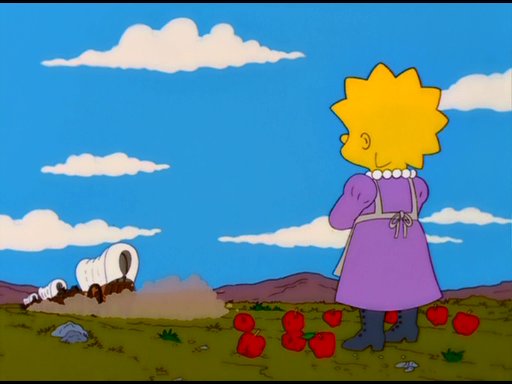
The second segment shows Lisa as Connie Appleseed, a female version of the American pioneer nurseryman Johnny Appleseed who introduced apple trees to large parts of Ohio,Indiana, and Illinois. He became an American legend while still alive. There have been numerous tellings and adaptations of his story, from plays, to guest appearances in books or tv. Again, in the Simpsons version, they adapt it very liberally for their own needs. Johnny becomes 'Connie' so that Lisa can 'play' the part of the main protagonist. Almost even more so than the first one, humour is used as a driving device in the narrative. The language used is quite modern, as the Simpsons would usually speak. The other characters are given parts in the tale as well.
"Tom and Huck" features Bart as Tom Sawyer and Nelson as Huckleberry Finn, both of whom are characters in Mark Twain's 1876 novel The Adventures of Tom Sawyer. Unlike the previous two, this is not based on a folktale; rather an actual novel. It is still interesting to see how the show adapts a popular American classic and makes it relevant and relateable to a modern TV audience. The writers make a point to use as much of the language and jargon in the books in this retelling, and the voice actors put on southern accents to better match the original location of the story. Because there is more definitive source material to base this part on than the previous few, it feels more true to the original and less liberties have been taken. This time, Tom sawyer is played by Bart, and Huckleberry Finn is played by Nelson. Humour features heavily yet again.
This episode is a neat example of how a cartoon can rehash a folktale in an entertaining way, making it appealing to modern audiences. In these examples, the essence of the tale is kept, while the characters and individual plot points can be changed dramatically.
Subscribe to:
Posts (Atom)