Showing posts with label Representation. Show all posts

13 January 2015

Reading: Issues of representation - Maureen Furniss

In a brief chapter on the analysis of animation, Furniss dicusses issues of representation within animated film and television. 'Issues concerning representation and cultural diversity are many and varied' (232). She briefly discusses culture and racial representation, but mainly focusses in-depth on female representation and women's issues. This perhaps is because as a woman she feels qualified to speak at length on the subject, or has a vested interest in it; 'recognisiton of one's own values, or the values being employed in writing the study, is impervative' (233)
She speaks mainly from the point of view of not just theorists of animation as an art form, but analysts of the animation industry as a whole. The chapter talks extensively about the industry standards that influenced representation, and marketing practices that coloured the reasons by which animation was historically produced. She shows how privilege and power lead to poor or lack of representation of marginalised groups: 'sometmes, depictions reflect specific agendas' (232).

When talking specifically about lack of representation of women in animation, we learn from her about employment practices in the American animation industry in the early to mis 20th century.Unfortunately, 'in the field of animation ... historically the women had no voice at all' (234) and so could not offer their own points of view or representation. This lack of women animators is problematic, as 'male animation creators and directors usually do not design female characters who have substance and provide strong, positive role models' (240) and either create secondary, objectified and stereotyped characters, or else leave them out all together.

Today the animation industry is 'a system that remains male dominated' (241), but fortunately, especially recently, the role of women has become more important within it and more women are being employed and represented. 'The voice of women in animation has become stronger during the past several years' (234). 'One area of concern for today's animation producers is the way in which women and girls are represented in their productions' (238); this issue has increased by a rise in women demanding fair treatment; an increase in women animators; and an increase in feminist sensibilities amongst male ones.Maany female animators have used the form in recent years to subvert the traditional representations and standards, and some have gona as far as to say that 'animation as a form offers such potential to explore women's issues in a way that simply isn't possible in live-action' (243)

Many of my own favourite animators, and inspirations to me, are female artists. Especially in popular televeision through networks such as Nickelodeon, cartoon Network and Cartoon Hangover, women animators have become much more prominent, and I ahve noticed shows which feature impressive women characters, even ss produced by men. For example, Natasha Allegri has her own show on Cartoon Hangover called Bee and Puppycat which not only is female-produced, but it's main character is a girl.
Bee from Bee and Puppycat
In my favourite animated TV show, Adventure Time, many strong females are depicted and they are an intrinsic part fot hey show. They were created by Pen Ward, who chose to give time and effort to representing women in a positive and contemporary way.

Princess Bubblegum from Adventure Time

Reference:
Furniss, M. (1998). Issues of representation. In: M. Furniss, ed., Art in Motion: Animation Aesthetics, 1st ed. Sydney: John Libbey, pp.231-246.

12 January 2015

Reading: Postmodern Fairy Tales - Bacchilega

My most recent reading into fairy-tale adaptation and re-structuring was Bacchilega's 'Postmodern Fairy Tales' (1997). All references in this blog post will refer to the first chapter form this book, titled 'Performing Wonder.' In Bacchilega's own words, 'this book explores the productions of gender, in relation to narrativity and subjectivity, in classic fairy tales and re-envisioned in late twentieth-century literature and media for adults.' (4) The first chapter functions as an introduction to her frameworks of analysis, including but not limited to feminism, postmodernism, and semiotics. It paves the way for more detailed analysis of specific fairy tale texts later in the book, which I will not delve in to at this point in time. Citing famous works by the likes of Zipes, Calvino, Carter and Warner; this piece offers an interesting divergence in opinion from other fairy tale theorists, and Bacchilega is not afraid to comment on and criticise the views of her predescessors.

The beginning of the chapter places Bacchilega's understanding of the difference between Zaubermarchen and fairy tales in opposition to my own; she emphasizes their contrast and places more importance on the media they are told through than I think is important: 'the classic fairy tale is a literary appropriation of the older folk tale' (3), which is true to an extent but not of pure vital importance. I personally see fairy tales as being a branch of marchen, or a section within its varied bounds, rather than a seperate but similar entity as Bacchilega seems to. She also focuses on the presumption that fairy tales are written with a child audience in mind, 'serving, more often than not, the civilizing aspirations of adults' (5), which from my previous readings I have found not to be the case. Instead, it seems which fairytales were written and performed for a mature audience, now modern adaptations have re-positioned then in their child-friendly re-workings as for a younger age group instead.
'Fairy stories play a role in education. Not only are children encouraged to retell or dramatize them in schools, but college students encounter them again in across-the-curriculum readers and in courses on children's literature and folklore.' (2) This I do agree with, though again I think it is symptomatic of modern interpretations and retellings rather than based on the original intentions of their writings.

Without specifying any particular adaptations, Bacchilega notes the prominence of appropriation by writers and tellers of fairy tales. 'The fairy tale, which provides well-known material pliable topolitical, erotic, or narrative manipulation. Belittled, yet pervasive and institutionalized, fairy tales are thus produced and consumed to accomplish a variety of social functions in multiple contexts and in more or less explicitly ideological ways.' (3) This is where the postmodernist structure for examining recent fairy tales and tellings comes in; Bacchilega suggests that the dual function of them both analyzes their original intertext's social project, and also re-inscribes them with new semiotic meanings relevant for a modern age (ar at least, this is how I understood her meaning!) In some instances of adaptation, tales 're-place or relocate the fairy tale to multiply its performance potential and denaturalize its institutionalized power' (23). 'Re-vision is not merely an artistic but a social action, suggesting in narrative practice the possibility of cultural transformation' (23)

'the fairy tale magically grants writers/tellers and readers/listeners access to the collective, if fictionalized past of social communing, an access that allows for an aparently limitless, highly idiosyncratic re-creation of that "once there was."' (5) In admiration of Carter's focus on fairy tale telling as a means to subvert opression by opressed peoples, Bacchilega metions the importance of the tale in all social classes as a liberator of expression and opinion: 'the fairy tale proves to be everyone's story, making magic for all' (6). The problem arrises when the writer or narrator does not take responsibility for their personal situation's influence, and instead presumes a 3rd person objective position. Different narratives between folk tellers and fairy tale writers often symbolize 'different needs and aspirations for different social groups' (6) which is important to understand when reading from a diverse group of tales.

A theory suggested in this chapter I find to be particularly interesting, and I have not come across it yet in any form. It is to do with the prominence of a naturalized magic within folk and fairytales which goes unacknowledges by either the characters within a story or the narrators themselves. 'We know that in folk and fairy tales the hero is neither frightened nor surprised when encountering the otherwold, receiving magic gifts, holding conversations with animals,or experiencing miraculous transformations. The numinous is artfully made to appear natural' (9) The question being, is this to disguise its artifice and social project? Bacchilega states the fairy tale is imbued with 'that magic which seeks to conceal the struggling interests which produce it' (7). The wonder of the wonder-tale is accepted by the readers/ listeners with a suspension of disbelief, and its purpose is to disguise the politics of the telling, and also to make the consumer more easily accept it without question, as they do with magic.

Carrying on this line of thought, it is applied to a feminist perspective in Bacchilega's analysis. 'This disguise seems doubly pervasive and dangerous when assumed by tales centering upon the experiences of women.' This is because of a 'long tradition of representing women both as nature and as concealed artifice' (9) like the concealed artifice of magic. It becomes symbolic of the construction of women in fairy tales: to go unquestioned in their representations.

'Women are commonly identified as being closer to nature than to culture, which in a patriarchal system makes them symbolic of an inferior, intermediate order of being'. 'Assosication of woman with nature paradoxically produces the artifice of 'femininity,' both as naturalizing make-up and as representations of womanly 'essence.' (9) Returning here to the idea that for men, the conflict of women's artificiality vs. true nature/form is an often recurring topic within fairy tales and their adaptations (see: Disney's representation of villainous women as made-up, concealed, and fake)

Reference:
Bacchilega, C. (1997). Postmodern fairy tales. Philadelphia: University of Pennsylvania Press.

9 January 2015

Reading: Angela Carter and the Fairy Tale (Introduction)


'Carter was drawn to the fairy tale as a vehicle of sociopolitical commentary'
(Roemer and Bacchilega, 2001)
Angela Carter's works, and her philosophy on the appropriation of folktales, has been a huge inspiration to me in my studies and animation work this semester. I picked up a book, entitled  Angela Carter and the Fairy Tale (Roemer and Bacchilega, 2001) which originally appeared as a special edition of the paper Marvels & Tales in 1998. I will go into detail in further posts about the individual contributions by various writers to the issue; for now I want to focus solely on the introductory chapter.
This chapter sees the authors give a general introduction to the world of Carter's writing, but more interestingly I found, an overview to the genre of folktales. Roemer and Bacchilega discuss the origins of folktales and their development through the years to become the fairy tales and marchen we know and adapt today. The terminology and semiotic differences between all of these terms I have found confusing, and previous explanations have been contradictory, but thankfully I found this piece to clear up the ideas in my mind.

'According to the Grimms' Deutsches Woterbuch, Marchen meant simply a "fictional tale,"' which is how I had come to understand the phrase. I generally lump all of folklore/tales/ fairy tales into this category together, and it seems I haven't been too far wrong: The Grimms placed 'diverse subgroups of folktales within the larger category of Marchen.'
'Marchen was typically rendered as "popular story" "wonder tale" or "fairy tale." Interestingly, the latter term derived not from any Germanic perspective but from the earlier translation into English of the seventeenth century French term conte de fées, which referred to narratives with supernatural beings as characters.' These 'supernatural' being tended towards fairies, hence the name, yet also included characters like beasts, metamorphosing humans, talking animals, etc. This means that tales that didn't include the fairy godmother character can still be included in fairy tale analysis. '[Carter] diffuses terminology by labeling "fairy tale" as a "figure of speech," moreover one used loosely to describe the great mass of infinitely various narrative that was, once upon a time and still is, sometimes, passed on by word of mouth.' All of this explanation provides clarity to me in studying folk and fairy tales. To understand the origin and terminology of these stories to begin with, gives me a better means of socio-politically contextualizing them.

We tend to think of the Grimms' and Perrault's adaptations as coming directly from folklore, as heard from peasant mouths directly. Apparently, they come less directly from the folk classes, and tend to be more attributed to bourgeoisie than supposed. Rather than talking to peasants and working classes to get their stories, the Grimms would work from written sources, journals, reviews etc; The Grimms would 'flesh out these verbal skeletons as their own perspectives inclined them. They reinforced the Christian aspects, the homey sayings, and the violence, while deleting sexual references.' 'The resulting tales were not primarily indicative of peasant values but those of the German middle class.' This was similar to what happened with the French tales in the case of contes de fées. 'The Grimms acted in accordance with the romantic perspectives of their day in focusing on the material rather than taking into account the socioeconomic conditions of the tales' informants.' As Carter has stated, the fairy tale was supposed to be a means of sociopolitical commentary, but in editing these stories in such a way, the Grimms and Perrault took away some of their embedded meanings and the voice away from the lower classes, to adapt it to tell the conditions of the higher classes instead.

'The contes de fées, like the oral tales still being told at salons, had specific sociopolitical functions. Informed by female perspectives and featuring female characters, the contes offered their creators opportunities to critique conditions of the day, particularly the social institution of forced marriage and the general lot of women in a predominantly male-controlled world.' Even though the class issue was being removed from them, they still served as a powerful tool by the 2nd class citizens (women) to provide commentary and criticisms of their situation. Although the now famous writers tend to be men, such as Perrault, in actuality it was the female attendees of the salons who provided the bulk of writing and analysis of fairy tales during the revival of the contes in France.

'The intermixing of folk (however folk may be defined), literary, and, in the twentieth century, mass media versions of fairy tales, sets in motion, in Carter's words, the transnational and "endless recycling process" of storytelling. It is the "user-friendly" nature of the tales which allows them to participate in a powerful "public dream".' 


References: 

Roemer, D. and Bacchilega, C. (2001). Introduction. In: D. Roemer and C. Bacchilega, ed., Angela Carter and the Fairy Tale, 1st ed. Detroit: Wayne State University Press, pp.8 - 12.

28 December 2014

Reading: Breaking in to the Movies - Giroux

(Unlike previous readings I have undertaken from the past few years- this one is from 1989 and as such is dated in its information and the absence of many texts.)

Giroux is highly crtical of Disney animated adaptations of tales as an institution. 'As one of the primary institutions constructing childhood culture, it warrants healthy suspicion and critical debate' (106). Disney shapes identities, through its prominent position in modern popular culture, and introduction to children at a young and impressionable age. It is imperative to analyse how Disney's films influence how children imagine their world. Giroux argues that to analyze the films with a critical eye, we as consumers can remain engaged and challenged. There is a tendancy for people and theorists to ignore Disney as mere entertainment. He contests that these 'do not exist in some ideologically free comfort zone' (111), and hence should be not be treated as such. In this chapter, Giroux idenitifies problematic elements of the famous Disney animated films, categorizing them as 'repetitive stereotypes that are characteristic of Disney's view of the childhood culture' (111) Disney production must be seen as a policy making enterprise, and as such held accountable for its short-fallings.

'Disney's themes function as part of a broader public discourse, privileging some definitions or interpretations over others.' (112) This attitude, especially one which is unquestioningly accepted by the public and fed to impressionable children, is of course problematic and needs challenging and discussing.

Representation of gender (particularly the female) in Disney films is one of the most controversial issues, both as identified by Giroux and also by feminist theorists in general. He lists many textual examples of events or characters which he feels to be questionable. Jack Zipes believes Disney films reproduce 'a type of gender stereotyping that has an adverse effect on children' (118). Its view of female agency is 'limited'.
Females in The Little Mermaid are 'subordinate to males' (114). I personally do take a bit of an issue with this 'definitive' reading of the matter, and would argue that based on a class reading, Ariel is the superior of Sebastian (a male character, even an elder of hers) and decides to ignore his instruction and authority often. Ursula, a female villain, is arguably (one of) the most powerful characters, and controls those around her including Eric, and her two male eel servants. Though I do understand where a general view of the the opression of women as a reading could come from.
All the rulers in the Lion King are male, females are subordinate, Giroux states. This reinforces 'Patriarchal entitlement' (117) and normalizes the presence of males in ruling positions.

A problematic aspect of Disney films, is that 'in both animal and human form, Disney portrays young girls as highly sexualized' (115). This comes from a patriarchal position of the male writer and the male gaze he bestows: of women as objects to be looked at with desire. Even Nala in The Lion King has fluttering, 'come-hither' eyes. It is of note that most of these women are indeed 'young,' and Disney makes use of their child-like naivety to construct a lolita-esque female figure. Older women are de-sexualised/ asexual in presentation, and rendered undesireable under the male gaze.

Also playing in to problematic representations of females and their agency, is the normalized occurence of a case of Stockholm Syndrome in Beauty and the Beast, where a woman is imprisoned by a male and learns to forgive and fall in love with him. Belle acts as a 'prop' to solve the Beast's dilemma. Beasts behaviour is 'horifically abusive.' In fact, looking at previous literary versions of this Beauty and the Beast tale, it becomes apparent that the treatment of Beeauty was originally a lot less sinister and cruel, and it was infact Disney that added this. See the following, from wikipedia, as one of the {original} versions, and note how it contains none of the violence towards and disregard to women that the Disney version holds:
'The Beast receives her graciously and informs her that she is now mistress of the castle, and he is her servant. He gives her lavish clothing and food and carries on lengthy conversations with her. Every night, the Beast asks Belle to marry him, only to be refused each time. After each refusal, Belle dreams of a handsome prince who pleads with her to answer why she keeps refusing him, to which she replies that she cannot marry the Beast because she loves him only as a friend.'
For several months, Belle lives a life of luxury at the Beast's palace, having every whim catered to by servants, with no end of riches to amuse her and an endless supply of exquisite finery to wear. Eventually she becomes homesick and begs the Beast to allow her to go see her family. He allows it on the condition that she return exactly a week later. 
Though one positive of the Disney film's narrative on gender is that it 'can be read as a rejection of hypermasculinity and a struggle between macho sensibilities of Gaston and the reformed sexist, the beast' (116)  
 
In the instance of Pocahontas, the problematic elements of female objectification and racial stereotyping are combined, incredibly. Unlike other adolescent Disney heroines, Pocahontas is not adolescent, instead a shapely women. The interesting thing about this is that the original person on whom the character is based was 13 years old. Disney has purposefully tried to distance their charatcer from 13 year old original, perhaps because her extreme youth would be seem as distateful to even suggest at sexualizing. Though the film manages to still portray women suspectly, and she is 'drawn primarily in relation to the men that surround her' (116). As regards the priviledged, white western re-writing of this tale, it 'bleaches colonialism of its genocidal history' (117).
In late 1609, an injury from a gunpowder explosion forced Smith to return to England for medical care. Historical records do not suggest that Smith and Pocahontas were lovers, or even that she was a suitable age for such a relationship. The first romance was written about them in the early 19th century, suggesting the story's mythic appeal.
In Mulan, the heroine 'challenges traditional stereotypes of young women' (117). One can see this as a feminine-positive reading at first, though intrinsically it still  conforms to the same old devides, and 'ultimate payoff of [Mulan's] own bravery comes in the form of catching the handsome son of a general' (117). By becoming a soldier - disguising herself as a man - she becomes one of the boys; 'rather than defining herself against the patriarchal celebration of war' (118). Mulan is an 'exoticized version' of an American girl, writes Giroux; holding true to patriotic, war-mongering ideals.


Racial stereotyping is another 'major issue' alongside mis-representation of women. There is a known 'legacy of racism' in Disney (119). This comes to play most visibly in the 'racist stereotyping in Aladdin.' It gives a depiction of Arab culture with a decidedly racist tone, through supporting characters who are portrayed as 'grotesque, violent, and cruel' (119). The grotesqueness comes in the form of hulking figures, hook noses and squinting eyes. Lyrics of songs sung by supporting characters contain words like 'barbaric'. Mispronunciation of names and racial coding of accents, which occur many times in Disney films, shows not necessairly negativity but instead ignorance.
In the Lion King, Scar (the villain) is depicted as darker than the other lions. The hyenas take on the discourse of a decidedly 'urban, black and Hispanic youth' (121) and employ people of colour for the voice acting.
'Whiteness is universalized thriough the privileged representation of middle-class social relations, values, and linguistic practices' (121).


Reference: 
Giroux, H. (2002). Breaking In to the Movies. Malden, MA: Blackwell Publishers, pp.100 - 122.

27 December 2014

Unnoted Reading (??)

 These notes I have transcribed and saved in a document on my computer, but I am not sure exactly from where I sourced them, so here they are below, unreferenced, until such time as I can determine where I originally read them from! Apologies!

'It is a mistake to assume that Disney's ideology represents a radical departure from the american norm. Its appeal is based on careful attention to centrist values' (238)

'The bodies presented are beautifully crafted fictions. Disney's narratives are, like all, ideological constructs and so too are its bodies.' (238)

'representing a configured idealized male body. the bodies of people of color and women, and therefore the narratives surrounding them, are largely absent' (238)

'Disney, as the master trickster on the scene, has taken control of bodies, mutated and mutilated them without mercy in the service of his narrative' (238)

'Walt Disney World does not just suppress people of color and women, as does the larger world; it has the tendency to suppress anything problematic, no matter how central to European American history. This suppression is part of its pleasure contract.' (238)

'Ordinarily, Disney grossly distorts culture differences, homogenizing them into a happy multi-cultural mix from which every alien element emerges Mickey-clean and ready for shopping mall consumption. It has at its disposal a vast array of techniques that neatly reinscribe difference, writing over bland diversity' (242)

'the male gaze dominates at Disney' (244) 'homosexuality is diffused' (244)

'Although Mickey's sexuality is normally repressed, one of Mickey's costumes in the late 40's and 50's was also reminiscent of the pachuco costume' (247)

'ambiguously coded bodies' (248)

'Disney has meticulously tailored its product to appeal to those who accept a normalized American version of culture' (248)

'representation is a pre-historic activity and pleasure. the pleasure of representation seems to stitch together the somatic and the intellectual. as our technologies for representation evolve, the complexities of the issues concerning them seem to evolve' (249)

one subtext of this essay is the violence of exclusion - "when the pirates of the Caribbean breaks down the pirates don't eat the guests"

for Disney, commodification rules

Reading: Somatexts at the Disney Shop by Elizabeth Bell

As I mentioned in the previous post when discussing Jack Zipes' investigation of the early success of Walt Disney; in the early days of animation it was a male dominated field, which was evidenced by the patriarchal ideology pushed within productions by the male animators with their 'phallic' pens and pencils. Bell in this chapter reiterates this point. She notes that in around the 1930's, Disney 'strictly divided labor into that performed by men and that relegated to women' (107), (emphasis added by myself). 'The production staff was overwhelmingly male except for 200 women in the Painting and Inking department' (107). She uses this as her introduction to a chapter about the politics of women's animated bodies; emphasizing the obvious correlation between the gender bias of the industry and the bias of the final product. 'With the name "Walt Disney Pictures," Disney wrote his name and ownership on the folk stories of women' (108). This is true both of tales written/ told originally by women, and tales in which women play protagonists. Disney is proudly stating that he has authored a portrayal of female characters from his male viewpoint, which is problematic to say the least. 

Some may argue against contemporary criticism of Disney by saying it was of its time, or it was unconscious of its faults in gender representation or cultural appropriation. However, Bell argues that Disney's animation is not innocent; 'nothing accidental or serendipitous occurs in animation as each second of action on screen us rendered in twenty-four different still paintings' (108). With so much scrutiny over aesthetics and form, nothing is encoded into the text by chance. 

In this chapter, Bell divides representations of animated women into three sections, determined by the subject's stage of life. The age, and aging of women is a contentious issue, especially in male-constructed texts and discourse. 'The exacting, communally created images of women by men are consistently rendered in a somatic triumvirate of bodily forms and snapshots of the aging process. The teenaged heroine at the idealized height of puberty's graceful promenade;' 'female wickedness - embodied;' 'is rendered as middle-aged beauty at its peak of sexuality and authority' while finally 'nurturing is drawn in pear-shaped, old women past menopause [...] as the good fairies, godmothers, and servants' (108). We delve into inspection of how females in each of these sections are visually coded, betraying the intentions of representation by the animators: 'this essay explores the "semiotic layering" in the construction of women's bodies in Disney animation' (109). 
The female characters in the folktale templates by the likes of the Grimms and Andersen are like 'painted ciphers' with no weight. However, with 'cinematic conventions of representing women, the levels become increasingly coded and complex. Disney's drawn women are transformed from weightless ciphers, drawn in black and white by men, into a second definition of cipher, texts encoded to conceal their meaning' (109) Ciphers of folktale heroines and female villains are transformed into 'conflicting codes of race, class and gendered performance' (110).

Firstly, Bell discusses the protagonists of many Disney fairy tale revivals - the heroines. Typically, 'Disney artists sketched the flesh and blood on these folktale templates with contemporaneous popular images of feminine beauty and youth, their sources ranging from the silent screen to glossy pin-ups' (109). The heroines are depicted as young, in their prime. These 'constructed bodies of young women' (110) have been produced under the male gaze. Animated heroines were 'both conforming to and perfecting Hollywood's beauty boundaries' (110). For source material, the animators looked at professional dancers' movements: 'their bodies built on the disciplined, expressive "naturalness" of dancers, have backbone' (112). This contrasts interestingly with the depiction, through their actions and discourse, that the heroines are usually seen as distressed damsels: spineless and unable to take care of themselves. 'While the characterizations of Disney heroines adhere to the fairy-tale templates of passivity and victimage, their bodies are portraits of strength, discipline, and control' (112). The juxtaposition of their aesthetic and their actions creates an interesting dynamic. 'The "backbone" of dance argues with the weakness of the narratized girls' (115).
These idealized young women have always been depicted in the male-dominated animation industry, in fact it wasn't until Beauty and the Beast that Disney had their 'first tale/film screenplay written by a woman' (114) The idea that women can produce more complex and nuanced female characters is a relatively contemporary notion. However, there is still a way to go in creating a positive, progressive medium for women creators and subjects in animation. Many of the tired tropes, such as the young, delicate heroine still exist, as is the rationale that they must find or marry a man to save them, and ultimately define them as characters. 'the tales still narrate and fulfill their destiny as marriage/reward for the prince/beast; their commodification in the marriage plot' (114). The heroines are desirable creatures, worthy of being rescued/saved and 'won.'  
'The young heroines are typical of "the perfect girl" whose body, voice, and destiny are a "mesmerizing presence" through which "girls [enter] the world of the local hero legend, and experience the imposition of a framework which seemingly comes out of nowhere - a worldview superimposed on girls but grounded in the psychology of men"' (121).

Ariel in The Little Mermaid source: http://princess.disney.com/ariel
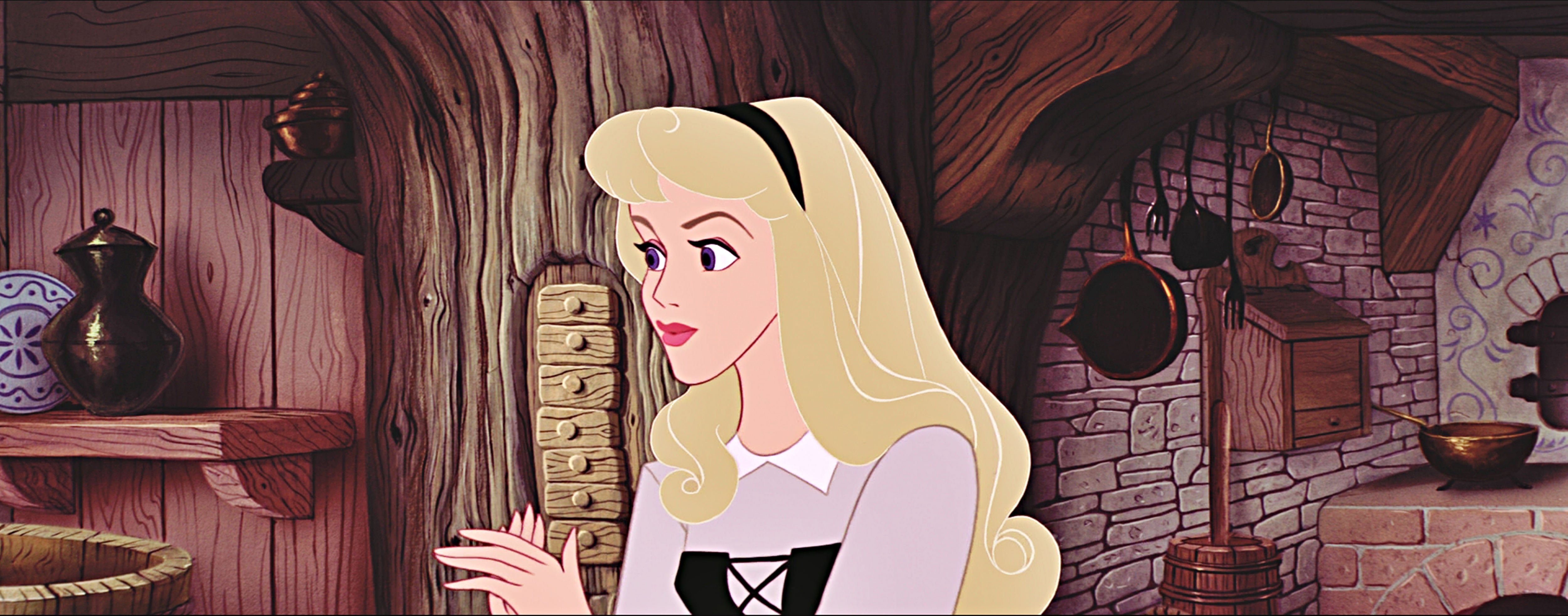
Aurora from Sleeping Beauty source: http://m.niusnews.com/upload/imgs/default/intern/bo0430/Walt.jpg
Heavily contrasting to the meek, vulnerable heroine is the evil female villain of fairy tales. 'Disney transforms the vain, active and wicked women of folktales into the femme fatale' (115). The images are reminiscent of film noir actresses. 'The readability of the femme fatale, painted in beautiful and shapely strokes' on the bodies of Disney's antagonistic females, 'is evident in the careful cosmetic of paint, cowls, jewelry, and "clinging back dresses"' (115). Snow White's Wicked Queen's beauty is 'sinister, mature, plenty of curves' (116).
These women have 'power and authority as femmes fatales, living and thinking only for themselves as sexual subjects, not sexual objects' (116). By depicting evil women in a sexualized, wanton light, the animators manage to 'subvert their authority even while fetishizing it - these deadly women are also doomed women' (116). Unlike the innocent, 'good' coding of the sexually mature heroines, these slightly older women are vilified for taking control of their sexuality, and being seen to 'flaunt' it, which is not approved of in the patriarchal society. Therefore, they must be punished. 'Their excess of sexuality and agency is drawn as evil' (117). In contrast to the younger heroines, 'congruous cinematic codes inscribe middle age as a time of treachery, consumption, and danger in the feminine life cycle' (116). The wicked women harbor depths of power that are ultimately unknowable but bespeak a cultural trepidation for unchecked femininity' (121). Interesting to note, it is these villainous women who are the only characters to address the audience/ camera/ screen directly out of all the women.
Animators designed these body types as symbolic of predatory animals. 'The construction of their bodies on predatory animals heightens the dangerous consumptive powers of the femme fatale' (117). For example, Maleficent was designed like a giant vampire bat. 'Disney's famous decree for Snow White's Wicked Queen, that she be a "mixture of Lady Macbeth and the big bad wolf"' (117). Ursula has 'consumptive, deadly' octopus tentacles (117). All the above emphasize unsubtley 'the potency of women's evil and their dangerous and carnivorous threats to order' (117). The last point made by Bell I find to be the most interesting, and perhaps, 'telling' one. Disney of course, comes from a time when American capitalism was coming into its own - when small media houses and studios were spreading into large national corporations and conglomerates. It was a time of the market and when the ultimate success was seen as being a productive, financially useful part of society. Men worked; produced goods and services and brought home money. Women provided for their families by raising children and completing all the menial household tasks. That was a woman's ultimate contribution to society, to be a good mother and wife. In this way,, Disney manages to vilify the antagonists in an even more insidious way. ball states ''it is appropriate that the femme fatale is represented as the antithesis of the maternal - sterile or barren, she produces nothing in a society which fetishizes production' (119). She was undesireable in Disney's ideal world.

Ursula from The Little Mermaid source: http://seriable.com/upon-time-season-4-alias-star-play-ursula/
Maleficent from Sleeping Beauty source: http://linksservice.com/disney-sleeping-beauty-maleficent/
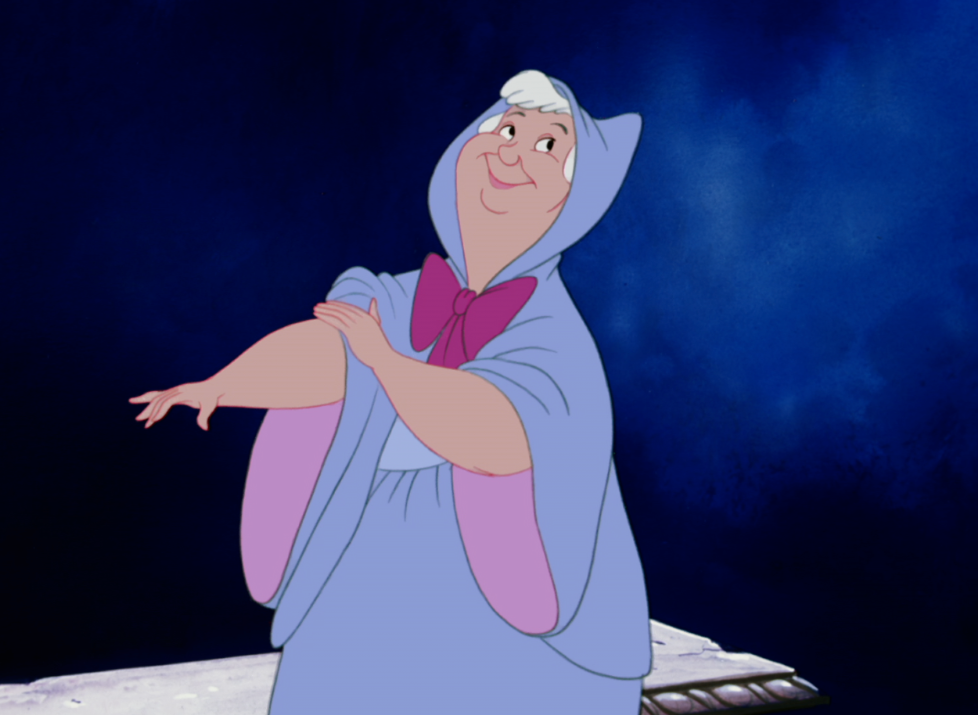
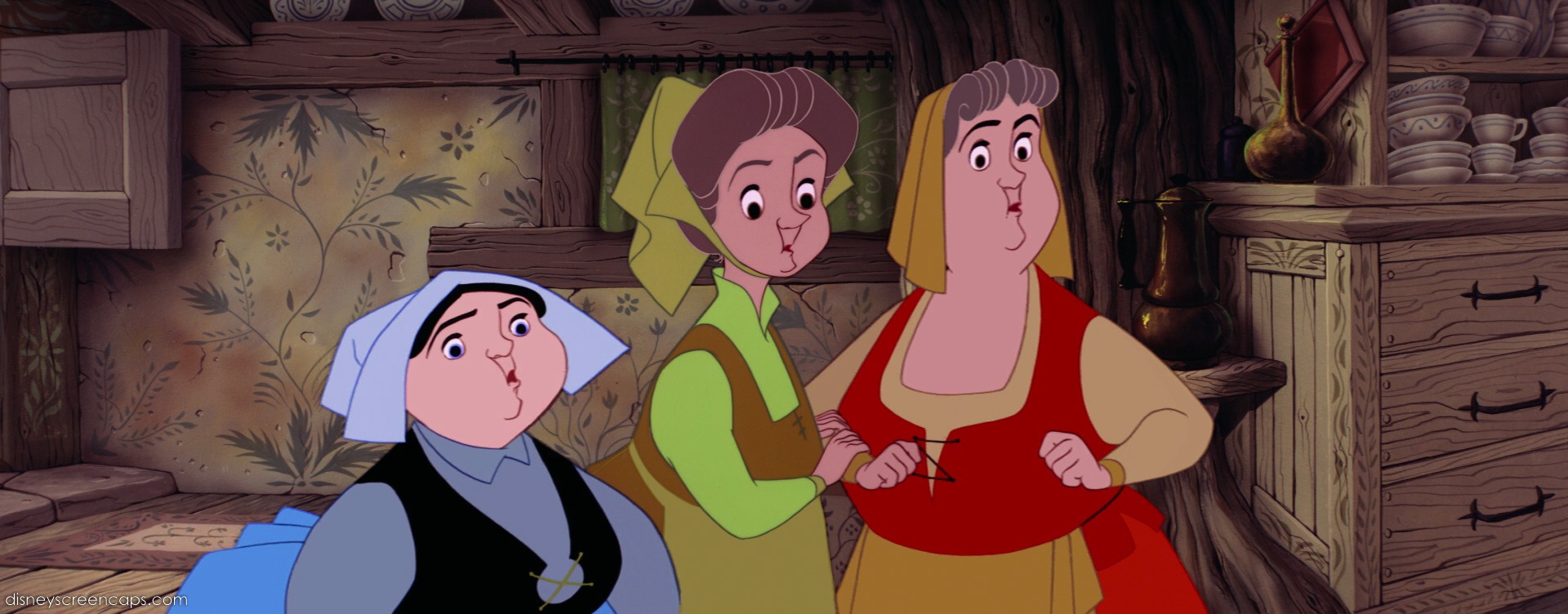
Finally we come to the final depiction of women - that of the last stage of the life cycle. Women past middle-age such and grandmothers are presented as maternal, caring, overseeing influences in the lives of the young heroines, and play a maternal role. The Disney animators used 'depictions of feminine nurturing and sacrifice in their depictions of good fairies, godmothers and servants' (118). These women were never the centre of attention, and never took away from the desirability of the heroines, they played a background role and a foil for the actions of the other women: 'never needful in their own rights' (118), which in Disney's world of female subservience was idealized. 'On the blank sketchpads of Disney artists, feminine nurturing and sacrifice are consistently drawn in contrast to the femme fatale. Unlike the shapely and mature curves of wickedness, Disney grandmothers are pear-shaped or apple-shaped' (118). Their animated bodies are drawn in direct contrast to the sexualized evil middle-aged women, any plumpness is confined to their stomachs and arms rather than hips and breasts. Visually, they are plain and undistinguished both beside the heroines and the villains, 'with none of the painted vanities of evil, they wear no cosmetics, jewelry, or adornment; indeed they have no lips. their hair, gray, silver or white, is covered. (118). Even the clothes that they are drawn in tend to be frumpy and conservative, more demure than the villains and markedly older than the heroines. These older women can be such good caretakers because they have nothing else left to give in life; they are no longer fertile and so useless for marriage or even desire of any kind. Their 'postmenopausal script of asexuality' (119) frees them up to give their undivided attention to others (heroines), rather than engaging in courting. The representation of frumpy, older bodies 'are nonthreatening, unavailable and harmless.' (119)

Fairy Godmother from Cinderella source: http://disney.wikia.com/wiki/File:Fairy-Godmother.png
The fairies in Sleeping Beauty source: http://disney.wikia.com/wiki/Flora,_Fauna_and_Merryweather
Reference: Bell, E. (1995). Somatexts at the Disney Shop. In: E. Bell, L. Haas and L. Sells, ed., From Mouse To Mermaid, 1st ed. Bloomington: Indiana University Press, pp.107-124.

15 December 2014

On Similarities with 'Stardust'

Similar to what I have previously attempted; I read an article discussing the representations of femininity in the fairy-tale retelling of Stardust (originally a 1999 novel by Neil Gaiman, later adapted to a film by Matthew Vaughn in 2007). It has many elements which, upon study, echo parts of the Crane Wife. In its most obvious, they both contain anthropomorphic non-human creatures who become human to take the part of the female protagonist. Here, using Sarah Cahill's 2010 writing, I will look further into the ways these tales compare and contrast.

The opening sequence of stardust exposes us to an overwhelmingly male perspective: we hear a male voice narrating and see an image of a room filled with nineteenth-century gentlemen scientists. Women within cinema, and culture in general, are coded as occupying the place of the image, as “connot[ing a] to-be-looked-at-ness” (Mulvey, 2000). Within this unassuming sequence, the film constrains its performance to hegemonic patriarchal framing within the male gaze. From the onset, the audience sees the authorship and control of men. Repeatedly in this film, this notion of seeing through the eyes of men crops up. The female protagonist, Yvaine, is caught shooting across the sky in her star form by Tristan. She is chased by him, and acts as the object of his desire throughout, articulating an unease concerning female relationships to spectacle (Cahill, 60).  This dynamic can be compared to The Crane Wife, both in its folk tale format and in my own re-imagining. The first time we see the Crane is when she is being stalked by the Hunter: under the eye of male gaze. Multiple times this scheme repeats in the story; for example when the Woodcutter finds the bird after pursuing her cry. The climax of the story centers around the woodcutter breaking his promise to the crane by looking at her while she weaves. The most important plot point hinges on whether he chooses to look at her or not in this critical moment.

The other major way in which these two tales are similar is with the tenuous balance between femininity and artificiality displayed in both. Associations between femininity and artificiality in literature and spoken tales have a long history, and are a major reoccuring subject in feminist readings. For film theorist Mary Ann Doane this idea that “it is femininity itself which is constructed as mask” troubles the patriarchal gaze, which relies on “the production of femininity as closeness, as presence-to-itself, as precisely, imagistic” (Doane, 2000). In Stardust the women, namely the haggard witches, 'attempt to control their representation in order that they might fit conventional ideas of feminine beauty' (Cahill, pp. 62). It is the rehashing of the threatening older woman vs. youthful, beautiful heroine trope which comes into play so obviously in this film.This ultimately revolves around conflict between female representatives of age and youth. Fairy tales tend to stage an anxiety concerning women who attempt to take control of their own image and representation, and such desire is presented as 'dangerous and ultimately self-destructive' (pp. 65) In Stardust the older women who attempt to take control of their own representation by appearing as desirable, ideal female stereotypes, are ultimately thwarted and turned back to their original form. The women to not have permission of autonomy over their own bodies and presentation. In The Crane Wife, the same fate befalls the Crane who takes human form. Not only does she become a human, but a youthful, beautiful female at that. She is seen to be 'tricking' her husband with her false appearance. Eventually, she is punished in some way for her false countenance and forced to remove her 'mask' and return to her original form. The overarching theme in folktales like this is that women, in a world dominated by the patriarchal gaze, cannot succeed in undermining this gaze. 
I think though, rather than completely falling into this hole, The Crane Wife manages to subvert this typical feminist failing of other folktales, and indeed, of Stardust. While the Crane does indeed lose her position in the human world by returning to her bird form, and abandoning the mask of the woman she wears; she does this by her own choice. She is not forced to by her husband nor external forces. indeed, it is she who originally demands control of the male gaze by requiring her husband promise not to look at her as she weaves. in this way she is more assertive a female character than many other heroines in other tale plots, and I think it can be argued that this is a powerful feminist message.

Jack Zipes contends in Why Fairy Tales Stick that 'we use the classical fairy tales in mutated forms through new technologies to discuss and debate urgent issues that concern our social lives and the very survival of the human species' (Zipes, 2006, pp.xiii). They point to an abiding anxiety in relation to regulating the spectacle of the aging female body. Women writers such as Angela Carter and Margaret Atwood, among others, have used the fairy-tale genre to engage with and uproot patriarchal representations of femininity and sexuality. The fairy tale thus offers a potent space in which to negotiate questions of gender and gendered representations. (Cahill, pp. 58)


References: 

Cahill, S. (2010). Through the Looking Glass: Fairy-Tale Cinema and the Spectacle of Femininity in Stardust and The Brothers Grimm. Marvels & Tales, 24(1), pp.57-65.


  Doane, Mary Ann. “Film and Masquerade: Theorizing the Female Spectator.” Film and Theory: An Anthology. Ed. Toby Miller and Robert Stam. Malden, MA: Blackwell, 2000, pp.502.

  Mulvey, Laura. “Visual Pleasure and Narrative Cinema.” Film and Theory: An Anthology. Ed. Toby Miller and Robert Stam. Malden, MA: Blackwell, 2000, pp.487.

Stardust. (2007). [film] United Kingdom: Matthew Vaughn.

Zipes, J. (2006). Why fairy tales stick. New York: Routledge.

13 December 2014

Reading: Three Revisions of Snow White - Cristina Bacchilega (1988)

I read an article about remediation of a folk/ fairy tale, which in this case was the popular story of Snow White. I thought this would be an interesting aspect to study, as the remediation of a tale is the main subject I will be dealing with. For centuries storytellers have retold tales in their own ways, embellishing the plot' with details peculiarly representative of both the individual teller and his [or her] time' (Bacchilega, 1988, pp. 1). The aim for the narrator/ story teller in a revision of the folk tale is to 'reinvigorate' the tale for their audience, 'making it somewhat "real" for them' (Halden, 1981).
In this article, Bacchilega compares and contrasts three retellings of the classic tale: The Snow Child by Angela Carter, The Dead Queen by Robert Coover, and Bartheleme's Snow White.
Barthelme's version can be seen as yet another 'retelling of the traditional fairy tale.' It is also a reading of it which, like The Snow Child and The Dead Queen, is 'grounded in a new understanding of metaphor and ideology in that traditional tale' (pp. 2). It reflects the period and situation from which the author/ teller comes.

In The Dead Queen, the tale of Snow White is retold through the medium of flashbacks. These are seen by the prince, Charming, the day after marrying Snow White and is now gazing speculatively at her dead stepmother in the glass coffin which once contained his wife. This develops an interesting relationship between the past and the present, and acts almost sequential to the original fairy tale, rather than changing it.The use of past tense, in a 'quasi-existentialist and reflective mode, lends itself to comic effects and parody' (pp. 7). 
Charming's questions about Snow White 'challenge the truthfulness of the process of female initiation, as the traditional tale presents it, and ask us to re-examine the meaning of her name, that is, the metaphor around which that same tale is built.' 
Marriage has always played an important role in folktale. In this example, their marriage intensifies their differences, and it 'magnifies the "frozen" and ideological nature of Snow White as a metaphor; an anthropomorphism, "a frozen void named Snow White"' (pp. 8). Snow White is condemned to be a heartless and unconscious child who cannot change and who has no understanding of her name (pp. 9).

Barthelme's Snow White  amplifies a narrative segment of the tale of Snow White; the heroine's stay with the dwarves. The novel has three parts (utilizing the significance of the Rule of Three in folklore), which represent on a narrative level Snow White's three-fold nature and the three phases of her traditional initiation process. It is told by several narrators, including Snow White, thereby dismembering the voice and authority of the traditional omiscient narrator (pp. 11). It it dissimilar to The Dead Queen in this way, because the narrative belongs not only to a male character. 
Barthelme systematically refuses to provide a linear narrative with a satisfying ending (pp. 12); it presents multiple in-conclusive possible endings. In Barthelme's Snow White 'language, structure, and style, then, are already a challenge to the conventions which regulate its intertext.' 'Snow White's beauty, which in the traditional tale reflects her inner qualities, is described in such a literal way that its symbolic significance is lost' (pp. 13). 'The movens of Barthelme's fragmentary plot is Snow White's dissatisfaction with language: "Oh I wish there were some words in the world that were not the words I always hear" Snow White is fully aware of being a prisoner of her own fiction' (pp. 15) Snow White wishes to escape from the voices articulating her existence, and instead speak her own dialogue and take control of her own actions. 

The Snow Child proposes no romantic ideals, no magic transformation; moving firmly away from its intertext. According to Angela Carter, myth and 'mythic versions of women' are 'consolatory nonsense' (pp. 16). 
The tale is set in 'midwinter' because of its strong transitional and symbolic resonance. Midwinter is strong and invencible, and the white snow is immaculate. This conforms to the Marchen's use of abstractly symbolic elements of nature. ,
The Snow Child has as its intertext not the Grimm version of "Snow White," but instead the one explicitly presenting the heroine's birth as the outcome of her father's desire rather than the mother's (pp. 17). Portrayed in a complex game of refracted and reverse images where sexual, social, and economic relations are explicitly linked together. disruption of the Marchen's cultural norms takes place: She picks a rose, the 'eternal' symbol of femininity in its mystical and sexual connotations; "pricks her finger on the thorn," somewhat mirroring Sleeping Beauty's coming of age; and "bleeds; screams; falls" (BC, pp. 117). Having physically come to completion (i.e., puberty), the Snow Child is ready for the Count who rapes "the dead girl" just as, in a seldom told version, Sleeping Beauty is raped in her sleep, rather than romantically kissed. As far as the Count is concerned, the Snow Child has lived her life and fulfilled her function as object of his desire: because of him, she has experienced some sexual and social transformation, but no psychological growth. And the absence of such growth in this version makes the inherent shallowness of her traditional cycle of transformation all the more dramatically visible (pp. 18).
There is no promise of happiness in the end of this tale, and there is no well-made narrative we can look back upon to confirm our ideas of what the world should be like. The Snow Child takes on the abstract style of the Marchen deliberately so as to undermine it. Unlike Coover's and Barthelme's revisions, Carter's does not employ any modern point-of-view techniques and relies on the mirror exposing its own fraud once a context is provided for it. in other words, Carter style mimics that of the folktale and finds in that mimicry its very difference. In spite of its use of some of the Marchen's stylistic features then The Snow Child forms a relentless critique of its intertext's ideology (pp. 19).

Snow White's story symbolizes the process of sexual, psychological, and social development in women - that is, female initiation (pp. 3). We are most familiar these days with the Grimm version because it is grounded in the nineteenth-century European dominant discourse about women and the bourgeois cult of domesticity, and so was permitted to become popular and widespread in a patriarchal society. The evil Queen's threatening and 'unnatural' craftiness must be punished with death because it is an expression of her physicality and her assertive creative energy. The heroine's socialization occurs through her relationship with men (the huntsman, the dwarves as miniature men, the Prince (pp. 4). Halden concludes that the character and story of Snow White resonate so deeply in our Western imaginations because they constitute a crystal clear metaphor of both sexual reproduction and narrative production as authorized by a traditional ideology of representation (pp. 6,7)
The 'plausible' tale of Snow White fulfills 'le contract tacite entre I'oeuvre et son public' and implicitly reassures its readers of the value of their cultural and narrative norms; these twentieth century revisions of Snow White systematically violate the 'grammar of motives' typical of legitimate, plausible narratives, and yet do not provide any other explicit norms to account for their socially and narratively transgressive strategies, other than a supposed desire to begin to imagine female initiation and its narratives anew.

Halden, J. (1981). Barthelme's Snow White: The Making of a Modern Fairy Tale. Southern Folklore Quarterly, 45, p.145.

12 December 2014

Chromatic Symbolism of Womanhood in Fairytales (Vaz Da Silva, 2007)

I read an article in a folk and fairy tale journal, which interestingly investigates the use of colour as symbolic in the presentation of heroine figures in lore. The article, by Vaz Da Silva, argues that the use of pure colors in folktales 'has little do with empty abstraction; rather, it is part of a general encoding of cultural values in sensory-based categories.' He lays his points out using historical contextual examples that colours are used in a patterned way, as functions are used. He explores chromatic codes as a means to uncover folk notions regarding womanhood.

I wanted to investigate this a bit, as I am now starting my character design, and wanted to know if I should be coding my colour schemes in any particular way to give even more historical and emotional resonance to the characters. 'Colo[u]rs are in practice semiotic codes.'
'Max Lüthi once remarked that whereas “[t]he real world shows us a richness of different hues and shadings . . . [b]y contrast, the folktale prefers clear, ultrapure colors.”'

Mainly discussed is the primacy of the triad of Black, White and Red. Vaz Da Silva refers mainly to the Snow White fairy tale to give context of how these three are used symbolically in heroine-making.  'Berlin and Kay have shown the primacy of white, black, and red in most color terminologies; and, as one might expect, a fundamental chromatic trio tends to convey foundational notions. they found that if a given language contains only two color terms, these refer to white and black. But if a language contains three terms, then it contains (in addition to the previous ones) a word for red. And so on and so forth concerning—in the following order—green or yellow, then blue, then brown, and finally purple, pink, orange, and gray.' This shows that the most striking three colours used, that contain the most cultural importance, are red, white and black. Such 'three principles of being' stand for, among others, heaven and chieftainship (white), blood spilling as in war (red), and sexual desire and regeneration (black). There is a link between tricolour heroines and feminine perfection, as witnessed in Snow White for example. Already I know that the Crane is white and black with a red streak on its head, and will play into this well. I plan to usitlize this triad even more in the design of the human version of the Crane, to connect her to the bird and also to give her cultural and historical value and significance.

The use of red and white goes beyond being emotionally symbolic. The red-on-white contrast used to be important in daily life. In studies on on colours and dyeing, it is found that 'European sources throughout many centuries contrast the relative dullness of natural hemp or wool colors to the expensive production of bright white and its even more luxurious tinting with purple. This means that for a very long time, dyeing amounted to tinting white with red.' In terms of feminine symbolism, there is a clear association between red on a white face; roses; and menses. Snow White has skin as white as snow, but blood red lips and full, blushed cheeks.

The contributions of Ovid, Shakespeare, and the Grimm Brothers suggest that red flowers stand for the fruitful aspect of womb blood as well as for youth. The red present in a woman's appearance suggests her fertility. Sometimes this can go so far in a western perspective as to suggest 'harlotry,' as opposed to the prudery of blue or the purity of white.' Artists have garbed the Virgin Mary in red and blue for centuries. blue signifies heaven and heavenly things. First, although Mary was heavenly begotten, she is still a woman able to conceive, which is where the red was usedin representation. In later depictions, the red was abandoned and her holiness and virgin pureness were emphasised in the use of just blue or red garments.

In folk tales, as elsewhere, white stands for luminosity and untainted sheen, thus for luminous heaven as much as for purity. But, precisely, our theme of red and white combined denies such untainted otherworldliness. White is pertinent regarding our heroine insofar as it is tinged with red. In sum, the purity of whiteness is there to be tinted. First, the ideal woman is otherworldly (which white represents). Therefore, as in real-world ancient techniques of dyeing, so in the symbolic realm of fairy tales white is the precondition for red—its chromatic background. They work more effectively as canvases for the other.

Both white and red stand for life, 'as they represent life-giving elements, such as milk and semen on the one hand, and blood and its attendant power on the other,' whereas black symbolizes
darkness and death. Black is the least commonly used and studied in terms of chromatization of female figures. It acts as a foil for the other two. As well as death and destruction, it also makes way for rebirth and renewal. This is interesting in terms of the ending to my story, when the Crane changes back into her bird form and starts life anew. She returns again to her natural state, and rebirths a life outside of the human world for her self; and enters the spiritual. I do not want to recolour the bird with black feathers, and it would take on more of the appearance of a cormorant rather than a crane. I have imagery in mind though, for one of the concluding shots to be of the bird flying from her home, into the distance above the tree tops. I could easily set this scene at night time, when her silhouette against the stars and moon in the sky would be black. This could add in the element of symbolic rebirth through darkness, and the suggestion that her whole figure is black.

Reference: Vaz Da Silva, F. (2007). Red as Blood, White as Snow, Black as Crow: Chromatic Symbolism of Womanhood in Fairytales. Marvels & Tales, 21(2), pp.240 - 252.

10 December 2014

On similarities with 'The Little Mermaid'

 'Embedded within this classic narrative about an adolescent girl's coming of age is a very contemporary story about the costs, pleasues and dangers of women's access to the "human world."' - Laura Sells, 1995
I decided to research a few more examples of remediated folkloric texts which share similarities with either the characters, plot, or issues raised in The Crane Wife. One which came across my path is the story of The Little Mermaid, originally a fairy tale by Hans Christian Andersen (1837). I read an article by Deborah Ross in a folklore journal which covered female protagonists in classic Disney films, and her analysis of the mermaid character in this paricular one struck me. Ross gives a feminist-positive reading of the story; one which is not often addressed in analysis (I find), and compares and contrasts the Disney retelling (1989) to the original tale . Undoubtedly, feminists have criticized The Little Mermaid's Ariel because she seems to have little ambition beyond getting her prince.  This is somewhat reductionist.  Ross argues that although many find her to be a meek, trope of a heroine, that the Disney Ariel can be seen as an independent, strong female. She carries an 'anthem of independence' (Ross, 2004). Sells, however, states that 'admitedly, the film is a problematic text for a feminist resistant reading, because it teaches us that we can achieve access and mobility in the white male system if we remain silent, and if we sacrifice our connection to "the feminine"'(1995). The Crane Wife could possibly also be read in both ways; in one sense the heroine is ultimately given agency and choice of her own situation. On the other hand, she could be seen to be conforming to male/ human ideals and sacrificing her own self and nature for access the patriarchal world.

Hans Christian Andersen’s original story is a 'tragic celebration of feminine self-sacrifice. His mermaid fantasizes about becoming human partly because she is curious about a world she has only glimpsed.' (Ross, 2004). More so than the film, she must sacrifice a huge part of herself to become human. She trades her tail for legs, which bleed profusely when she walks, and loses her voice permanently as her tongue is cut out. Naturally in the Disney version the mutilation and blood would have to go (Ross, 2004). The retelling is directed at a younger audience who could not handle gore, and it is sanitised so that she loses her voice only temporarity, and her legs work perfectly. This parallels the transformation the Crane must undergo in The Crane Wife, where to access the world of the male she must change her form, and conform to ideals of his gaze. the metamorphosis closer resembles the Disney version's retelling, where there seeminly is no pain involved in gaining a human form. The comparison is instead to be made between the original Andersen mermaid's suffering, and the pain that the Crane must go through to maintain her place with her husband. She ravages her body to produce cloth for him to sell, tearing out her own feathers for the weave. She must go through pain to enable them to live 'happily' together. In both instances, the women go through physical as well as emotional sacrifice and torment for their male counterparts.

Both The Crane Wife and The Little Mermaid emphasize issues of choice and agency. Ariel wants access, autonomy and mobility (Sells, 1995). She believes the human world above the sea to be a utopia of free movement: she dreams of legs first for “jumping”and “dancing” and “strolling,” and only secondarily for marrying (Ross, 2004). All of these verbs are representative of mobility. Her fascination with the human world only then becomes transformed into love for Prince Eric. Initially, it was not the man she was yearning, but the world to which he belongs. This could be read as the desire of women to access the patriarchal, male-dominated world, in which she is by nature offered no power. This is seen as the desireable ideal: the 'real world.' In The Crane Wife, the desire is formed in reverse order: the Crane attempts to access the 'real world' so that she can be with the male protagonist. Her love is first and foremost for him, rather than the life he represents. In fact, we can assume that the life of mortality and domesticity seems less suited to her than her original life in the forest. Whereas Ariel imagines this 'other world' as in a sense more her own than her actual world.

'Ariel's ascent to the "real world" easily becomes metonymic of women's access to the white male system. Those who are priviledged in the white male system are oblivious to anything outside the system. The sea world is rendered either invisible or mythic while the land world is endowed with cultural validity.' (Sells, 1995). Similarly, in The Crane Wife, a contrast can be made between the natural animal-populated world of the forst, and the domestic human world of the Woodcutter. The Woodcutter character is oblivious to the fact that his wife used to belong to the former, in which he had previously met her. No individual is expected to cross the boundaries between the two, and the mystical and otherworldy is not expected to encroach on the ordinary.

In Andersen's original, the human world is described as wonderous, beautiful and full of life. The images the movie uses to tell the story give the agency of Ariel a reverse spin. In the Disney film, the underwater world is fantastic, while the land is dull and plain to us. Whatever Ariel might say, or sing, what we see her do is flee a world of infinite possibility to settle in the land of the banal. Her fantasy is a sort of anti-fantasy (Ross, 2004). Yes, she gets her legs, she makes her stand, she marches - but only down the aisle, to marry some guy named Eric. We read the Crane as doing virtually the same thing; of entering the mundane and abandoning the fantastic.

'Many fairy tales, and many more movies, end with a wedding. When the marriage seems to grant the heroine true personal fulfillment and possibilities for further growth, the ending may actually seem like the beginning of a new life' (Ross, 2004). Each of the heroines in these three versions of folkloric tales have a drastic change in situation by the conclusion of their respective stories. In The Crane Wife, the heroine abandons her husband and marriage to return to her true form and her original home. It does not end conventionally, in a 'happy ever after' marriage. She goes through a process of self-actualization and uses her agency in choosing her own path. In Andersen's tale the mermaid dies because she fails to earn the prince's love (Sells, 1995). The disney version subverts the self-actualization of the herione by ending the story in a marriage to Eric. She ends up not independently strong, but settling for a partner. The original finds her granted with immortality through her sacrifice. Both this version of the mermaid, and the Crane, achieve the otherwordly and ethereal.

References: 
Ross, D. (2004). Escape from Wonderland: Disney and the Female Imagination. Marvels & Tales, 18(1), pp.53-66.

Sells, L. (1995). "Where Do the Mermaids Stand?" Voice and Body in The Little Mermaid. In: E. Bell, L. Haas and L. Sells, ed., From Mouse To Mermaid - The Politics of Film, Gender and Culture, 1st ed. Bloomington: Indiana University Press, pp.175 - 192.

On similarities with 'Fitcher's Bird'

"The transvestism that finally saves her, and results in the demise of evil and patriarchy, is her disguise as a bird—a fantastic bird, a possibly androgynous bird." - Pauline Greenhill (2008)
“She looked like a strange bird, and it was impossible to recognize her” - (157, Fitcher's Bird)

I read a critical literary analysis of the Grimms Brothers' folk tale 'Fitcher's Bird,' which to me conjured up a great deal of similarities with the Crane Wife. Through the social and feminist analysis of the former, I was able to better understand the Crane Wife and issues I may face within my own adaptation of it. Fitcher's Bird can be seen as a contra-patriarchal story, where the typical hegemonic power of males in folk tales is subverted. 
"Unnamed, except as Fitcher’s Bird, the main protagonist is an everywoman who undermines actual and symbolic patriarchy by a series of actions that also expose the Freudian and Lacanian creation myths about women. The story subverts patriarchy, heterosexuality, femininity, and masculinity alike." Comparatively, the protagonist of The Crane Wife is the title character: a heroine and a bird in one. 
The heroines of both tales perform secretive actions that disclose the main male character’s true nature, with the the women’s ultimate survival as autonomous beings depending on these secrets being uncovered. The contrast between the two is clear; in Fitcher's Bird, the bird discovers the man's terrible hidden secret. In the Crane Wife, the bird is the one who must keep the secret of her identity from the man. “Fitcher’s Bird” is difficult to convert into a tale about the dangers of female curiosity; it’s about the need for hiding objects and actions from, and deceiving, patriarchal male figure.' This too is true of the Crane Wife. The power of the man is subverted by female autonomy in both instances. 'Women’s duplicity, feminine duplicity, is not only powerful; it is also a primary survival strategy.' In Fitcher's Bird, it is bravery of the heroine which allows her to uncover the secret, which is more powerful and morally upstanding than the simple curiosity of the man in The Crane Wife who breaks his oath to his wife,

In The Crane Wife, unusually, the secret is held by the female and the onus is put on her male partner by her not to disturb her secret, whereas in many other instances it would be the male controlling the female to do/ not to do something. Such orders become logical in the context of patriarchy, where men may figuratively or even literally own their wives’ bodies and services, and, ultimately, their lives. The Crane takes control of her situation and relationship by denying complete ownership over herself and laying her own rules and boundaries. 

The women in both tales break common tropes of female subjection through autonomy, which 'by implication revisions the constitution of women beyond the patriarchal gaze.' 'While these processes of male looking and the objectification of and violence against women do take place in the tale, they are narratively disrupted, overturned, reversed, and/or turned against male figures by female figures.' Both women end the stories away from their captors/ partners, proving 'They don’t want the men who want them, and they certainly don’t need these murderous patriarchs.' 'Contra-patriarchally, the story requires readers/hearers to identify with a woman in order to survive at the end.'

Fitcher's Bird has the support system of female companionship and solidarity to help her through her tale, while the Crane Wife can use only self-reliance. 

The bird form of the female protagonist in 'Fitcher's Bird' is referred to throughout as an 'avatar.' In this way, the bird form of the Crane Wife could be seen as her avatar. A queer reading of these avatars highlights how women save themselves by creating an object that represents what the heterosexual gaze loves in women: a beautiful appearance. 'When the youngest sister does Fitcher, as a Bird, he doesn't recognize the fact. This reverses and subverts the patriarchal gaze, which is supposed to be directed by and from the male toward and against the female, not vice versa.' Similarly, the Crane acknowledges the man without him being aware of her female presence. She has a greater grasp in understanding the world around her and their positions within it than the male. The man cannot recognize the Crane in the woman he marries, because he is so concerned with outward appearances. Fitcher sees women as no more than a collection of parts.'The protagonist creates
avatars, and they successfully stand for her, because she is unknown and unknowable. She uses the recognition that she is known only for her qualities (or even for her supposed qualities of traditional feminine domesticity and appearance); she develops her own assemblage, with parts that are (again) both her own and not her own.'
The Crane Wife's contact with the outside and connection to the public sphere is enabled only through the use of her avian avatar. To compare. the female in the other tale also does engage in the public space, though in disguise as her Fitcher’s Bird avatar. Both women make their way into public space as a transvestite, but they don't 'take the robes of the patriarchy, but those of the animal world.'

Neither tale utilizes the typical 'happily-ever-after'device of marriage and heterosexual companionship, and both end with the female freeing herself in someway from the male, to live away from patriarchal oppression.

Reference: Greenhill, P. (2008). "Fitcher's [Queer] Bird": A Fairy-Tale Heroine and Her Avatars. Marvels & Tales, 22(1), pp.143 - 167.


21 November 2014

The 'Gay Agenda' in Animation

Cartoon Brew recently featured an interesting article by Neill Emmett investigating the presence of homosexual characters and symbols in animation.
I thought it was fascinating to read about, since it plays so heavily into breaking the boundaries of societal norms, and the questions of taste and ethics. I for one, always assumed animation to be a medium in which experimentation could openly be done, and status quo could perhaps more easily be broken than in live action or other media. Any progress however that animators have achieved in creating more representations of gay characters has been hindered by backlash of conservative parents and religious groups who want to 'protect' children from viewing and possibly being influenced by such things. This is when it becomes apparent how important the ethics of our portrayals in animation are, and how we must consider our audience closely when developing characters and stories.

‘Then there’s the recent Sponge Bob Gay-Pants dilemma. Look… if you don’t want people to think Sponge Bob is homosexual, then don’t feature him in a “diversity” video which obviously is implying that sodomites should be accepted as well. The flashing colors of Sponge Bob are a clear indicator to me. Everyone knows that the rainbow has become the hallmark of the homosexual movement. By the way, nothing is any more blasphemous to the Bible than the Sodomites stealing of the rainbow. It is God’s rainbow, not the homosexuals!’
Image source: superbwallpapers.com/cartoons/spongebob-squarepants
In one sense, cartoon characters often are read as homosexual by detractors (as above) and in another they can be read in this way by fans, but neither of which necessarily means that their sexuality is explicit or even intentionally implied by the creators. Audiences can read characters and situations with very different meanings than they were ever coded to have. 'This is the result of subcultures appropriating aspects of mainstream pop culture.'
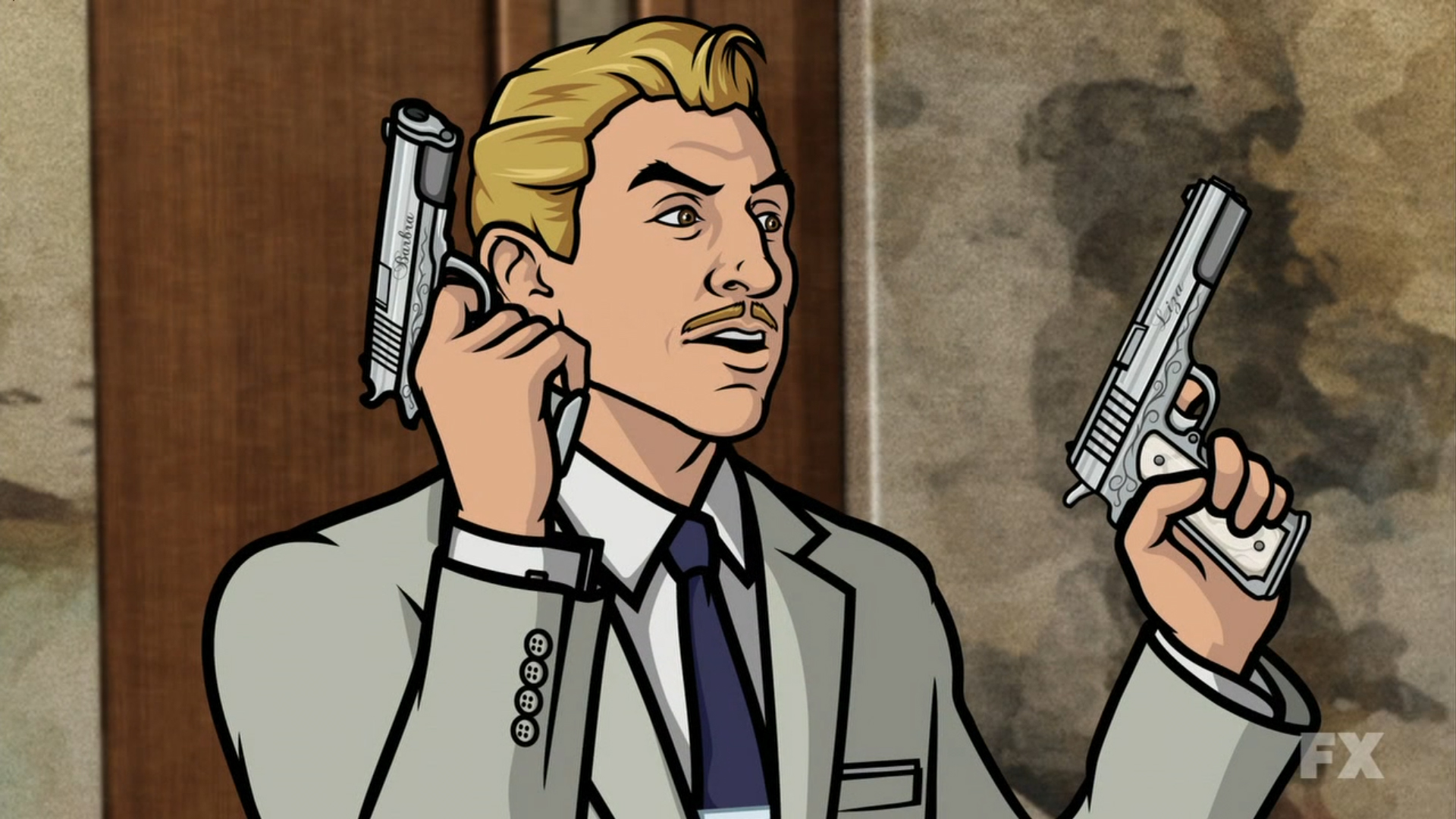
For the first time now we are seeing openly gay characters in animation, both adult and children's, which is a huge step forward for fair representation, equality and freedom of storytelling. 

Ray Gillette from Archer, Image source: archer.wikia.com/wiki/Ray_Gillette

Xander from Drawn Together. Image source: cc.com/video-clips/ndowqs/drawn-together-producer-s-profiles---xandir-p--wifflebottom
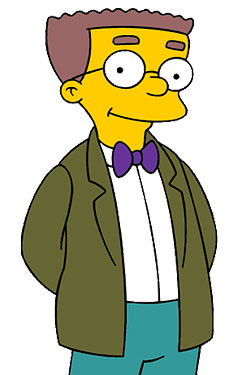
Smithers from The Simpsons. Image source: nymag.com/daily/tv/2009/09/revealed_the_real_smithers
ETA: while this article deals mainly with Homosexual characters, it is worth nothing that characters from across the whole LGBTQIA spectrum have started to become more widely acknowledged and represented in animation. Also, the subjects this article deals with are in a western sphere, taken from a western viewpoint and so do not deal with the great deal of portrayal there is with LGBT characters in foreign animation such as Anime. 

Reference: 
Emmett, N. (2014). A History of the ‘Gay Agenda’ in Animation. [online] Cartoon Brew. Available at: http://www.cartoonbrew.com/ideas-commentary/a-history-of-the-gay-agenda-in-animation-105951.html [Accessed 21 Nov. 2014].

4 November 2014

Mary and Max (2009)

Mary and Max was a really funny experience to watch; I decided to analyse it through the lens of the readings I have recently done about representation. I want to approach this in a theoretical sense to help be develop the theory behind my own story. Even though it is a stop-motion animation using small models, with a cartoonish aesthetic, it deals with VERY adult subject matters. The story revolves around two central figures; a young Australian girl and an older American man, who become unlikely friends. Where at first i thought the film would follow a very simple plot line and have a hopeful message and happy ending; it had lots of ups and downs in pace and story, like an emotional rollercoaster to watch!
Max's character has asbergers syndrome as we discover part way through. This brings to the forefront questions of representation: how do you portray a character with an invisible disability? It run the fine line between being very specified, and appealing to  wide audience also. It does this mainly through black humour, where we can sympathise with Max's every day struggles while also being amused (but not in a cruel way I don't think). The fact that it uses both 3rd person narration and 1st person (where Max and Mary read each others' personal letters aloud) probably makes it easier to understand life through Max's PoV, and through literal narrative description rather than through visuals alone. I think that it is definitely a benefit of having narration in a story; and I am not quite sure yet whether I want to incorporate it in to my own yet. I will have to see how easy it is to tell the story through visuals, and if I need any aural aid for this.

The lighting and colour schemes changes between the two characters' environments, representing the way they view the world around them. For Max, New York is scary and grey and bleak. It shows how I can use colours, lighting, and the surroundings of the characters to reflect the storyline, emotion and characters' personalities, rather than just relying purely on their actions.

Representation of women comes through the depiction of Mary's growth through adolescence to womanhood. She goes through a great deal of self-loathing and deprecation, which she describes verbally and we can see in her actions and reactions to her own situation. As a child, she is not in control of her place in the world. She is controlled by her family, her age, her location. Later in life she begins to grow her independence, and be more assertive.

27 October 2014

Representations of Female Characters Research

Law, S. (1997). Putting Themselves in the Pictures: Images of women in the work of Joanna Quinn, Candy Guard and Alison de Vere. In: J. Pilling, ed., A Reader in Animation Studies, 1st ed. Sydney: John Libbey, pp.48 - 70.

 In the realm of Media Studies, which encompases animation, the issue of the representation of women has become a central concern. How do you visually explore the nature of femininit and the experience of being female?

Typically, according to Joanna Quinn (director), both male and female animators portray female characters in different ways. Is the gaze a predominantly male or female one, with male or female subjects? Are the objects male or female? Quinn's films refect the gender politics of male-female relationships, through the medium of humour. She tries to empower as opposed to degrade female characters through it's use. They also foreground the theme of female solidarity and the justification of pleasure for female viewers.

It is important to steer away from the stereotyped images of women in the animated world; sexy Jessica Rabbit and virginal Snow White; and instead take have a fresh and nuanced aproach to portrayals. You can avoid idealising a character's physical form and instead focus on their characteristics and personality, making them more three-dimensional.

In the traditional sense of gender, 'appropriate' depications would have a physically smaller female than male, taking up less space (both physically and as a metaphor for societally).

In my story, the main narrator will be the Woodcutter, whom the view follows. He will not have overall authority though despite the focus on him: the Crane subverts his primacy through the autonomy of her actions in conflict with his desires. She has the untimale control of the relationship, and is the one to eventualy leave him. The metamorphoses between bird and human reflects her ability and potential to make her own choices. The themes of representation will be primarily be explored through visual imagery, as opposed to through dialogue.The experience of being female is located within the context of a particular female character's story; in this instance, the Crane.


It becomes problematic where in the telling of the story, the human version of the Crane is supposed to be uniquely beautiful, and an idealised physical form. Does that make the interactions between herself and the Woodcutter less significant? What is his motivation for maintaining a relationship with her, other than her physical beauty? Will her traditional 'beauty' undermine the importance of her character at all? I want to create a contemporary film and avoid a post-modernist take on female representation. If I could, I would create her with a simple, plain, non-beautiful image, but I feel that it is an imporant aspect to the original story. The beauty and elecgance of the Crane as a bird has to be reflected in her human shape also, with graceful legs, sleek plumage/hair and willowy figure.We also mainly view her through the gaze of the Woodcutter, who finds her beautiful in a romantically-inclined way.

The Crane's desire is to provide for the Woodcutter, and be a good partner to him. She has a deep affection for him, so is content to change her physical shape, change her environment and nature, in order to care for him; both in love and gratitude. She does not however, find satusfaction in her situation. By conforming to a stereotyped nuclear marriage role, she ends up harming herself. She literally becomes weaker and pulls out her feathers to maintain her position. Eventaully, this unrealistic standard becomes too hard for her to maintain, and with the first excuse/reason she has, she flees the Woodcutter and their marriage. She regains the freedom in her independence and autonomy; becoming her true bird form again, and literally flying away from her domestic life and responsibilities.Her liberatio is of her own doing.

There is no true resoluion in this tale of the faltering relationships between lovers, which hopefully will make it true to real life experiences, instead of the tired, 'fairytale' happy ending.